You may be familiar with the fable of the Phoenix, the beautiful bird that burned and died after a spark from a cherub’s flaming sword fell into its nest. Once the flames went out, a single red egg remained and from the ashes, a new Phoenix bird hatched and so the cycle continued. This legend is similar to the lifecycle of the Honda Civic Si hatchback.
Although the Civic hatchback was never originally intended as a performance vehicle, but rather a people mover, enthusiasts everywhere have embraced it with open arms. In a sense, the Civic is what started the wheels turning in the aftermarket and for obvious reasons. There are plenty of Civics in used car lots and in the local classifieds, they are easy to work on, there are a variety of engine swaps available and the number of aftermarket products available is almost limitless. The Civic has become the icon car for tuners.
Life was great for the followers of the Japanese pocket rocket, but like the Phoenix, the Civic Si model was dropped in 1996 and in 1998, the Civic hatchback was discontinued. The Civic was dead and while the coupe version was still in production and available with the 160hp B16A engine, the hatchback was still missed. Some say that the hatchback should have come with the B16A engine, as we know that the combination makes for not only a quick car, but it was economical as well.
The decision not to utilize that powerplant could have been made for a couple of reasons. The cost of the hotter engine may have driven the price of the Civic out of the budget range of targeted consumers, plus it would have outperformed both the Integra GS-R, as well as the Prelude Type-SH. Either way you sliced it, Si hatchback fans were out of luck.
Thankfully, Honda decided to reintroduce the ’03 Civic Si hatchback (EP3) and like the Phoenix, the Civic Si hatchback was reborn. It wasn’t long before the aftermarket began to develop and prototype everything from cold-air intakes to turbo kits for the new EP3. We would be the first to admit—and in fact went on record as stating—that we didn’t particularly care for the styling or the engineering of the EP3 in its stock form. I recall seeing the EP3 at the 2002 SEMA show and thinking that the dash-mounted shifter was a monstrosity and that Honda had really dropped the ball on this one. But a fellow enthusiast told me that I had to actually drive an EP3 before passing judgement.
Well, he was right. After driving the EP3, the shifter felt quite natural and more importantly, the new KA20 VTEC-i engine was a nice improvement over the previous B-series VTEC. The engine was flexible and eager to rev and put power down to the ground with its plus-10 lb-ft of torque over the B16A engine. Honda had brought back the hot hatch and hopefully, it is here to stay.
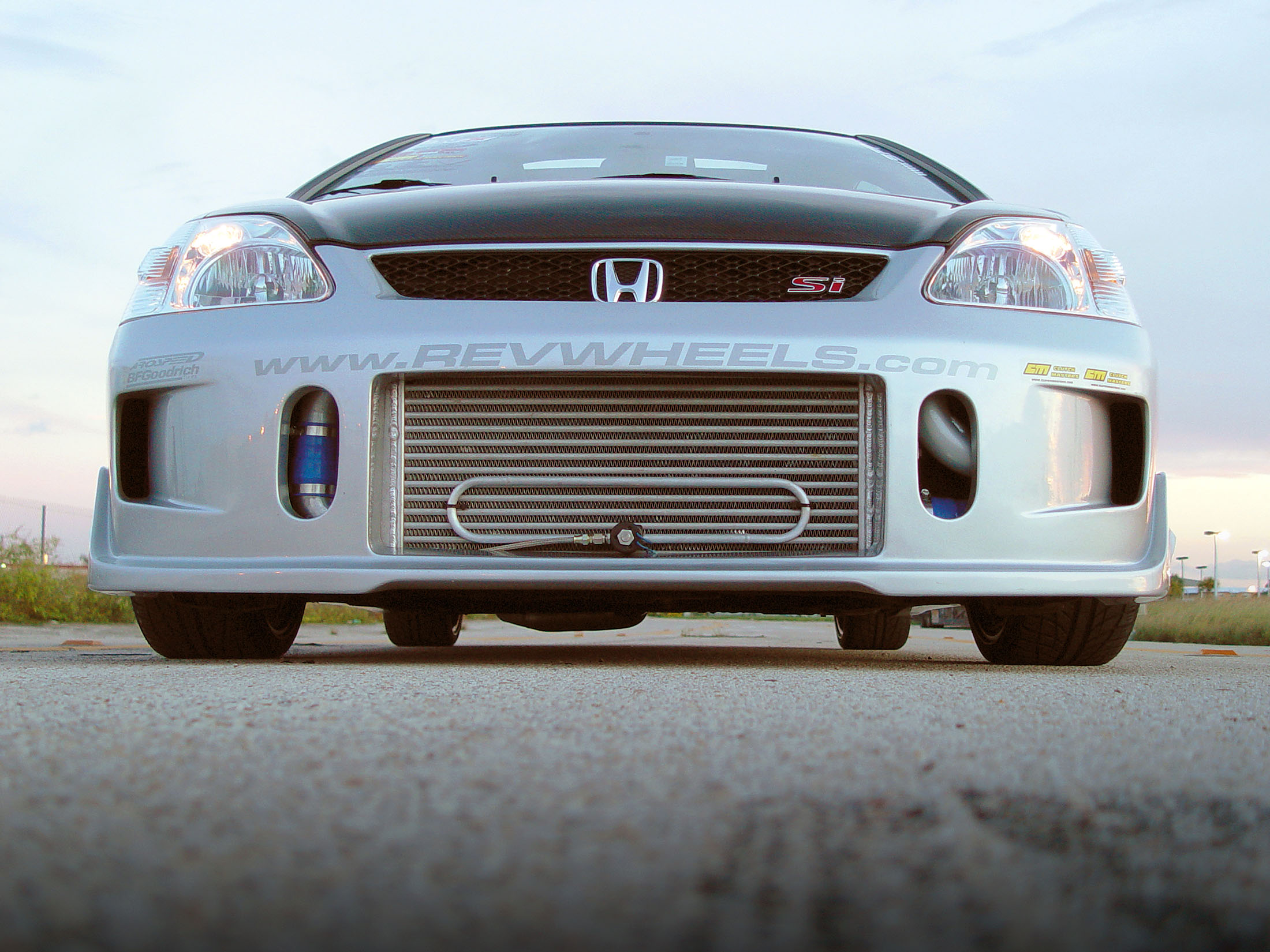
Robert “TS”Martel of Miami fell in love with the car and shortly after getting one he upgraded the stock 15-inch wheels with 19-inch Arospeed Xpress wheels and BFGoodrich g-Force T/A KDW tires. Arospeed adjustable coilovers, BuddyClub2 replica body kit, grade-A carbon fiber hood and more Arospeed accessories than you can shake a stick at, as well as the usual upgrades (which were minimal at the time) were also incorporated. Martel yearned for more performance, so he looked to Frank Smith, owner of South Florida Performance (SFP), for his 15 years of automotive performance experience. SFP had just developed a new turbo kit for the EP3. This would be Martel’s E-ticket ride.
The turbo system consists of a Garrett T3/T04E, 38mm TiAL wastegate, SFP tubular exhaust manifold, 2.5-inch downpipe coupled with a 3-inch cat-back exhaust system, GReddy Type-R blow-off valve, SFP 26x12x3.5-inch intercooler with an XS Engineering core and end tanks, and SFP mandrel-bent, powder-coated intercooler piping. EP3 tuners have found out that when adding forced induction to the KA20 series engine (which has a non-return fuel system), special attention must be paid to the fuel and engine management. All of this hardware being added to the engine would prove to be overwhelming for the factory ECU programming, which is not designed for forced induction. Thus, a custom-tuned engine management system is used.
The fuel system was upgraded by adding a larger fuel pump and 310cc injectors. Smith also incorporated an Aquamist water injection system that was modified to use methanol, which reduces the chances of engine-killing detonation. A Stage 1 EFI single Shark nozzle wet system jetted for 50 hp and N-terCooler by Nitrous Express were installed for both performance and sheer intimidation factor. (Face it, twin nitrous bottles look hot.)
After all was said and done, the boosted EP3 puts down a respectable 270 hp and 215 lb-ft of torque through a Clutch Masters clutch setup and to the wheels with only 5.5 psi of boost on the 9.8:1 compression engine. Martel has taken the car to the dragstrip where he was able to clock a wheel-spin-induced 13.5 at 106 mph.
This EP3 was designed for the street and for Martel’s own enjoyment. That is why his complete car audio system from Phoenix Gold consists of a trio of Phoenix Gold Octane-R 800-watt 8.0:1 amplifiers that drive three Phoenix Gold Octane-R 12-inch subwoofers in a custom enclosure. A pair of Octane-R 400-watt 4.0:2 amplifiers drives the front stage. The conductor or maestro in the audio system is a Pioneer P7000 head unit that features a 7-inch LCD screen—a mandatory item these days in hot street machines. While all this gear may weigh more than Martel would like, it’s a necessary evil since no tuner car is complete without a serious audio system.
All in all, this EP3 exhibits a nice blend between show and function. From the body kit and HID headlights to the Arospeed big brake kit that hides behind the rollers, Martel has brought the Civic Si hatchback from the ashes even better than Honda did. That is, unless Honda releases the Type-R EP3 on our shores. Keep your fingers crossed.