


THE AUTO BUILDER
Featured

All Mocked Up
When building a street rod, unless you are building it to look like the day it rolled off the showroom floor, you find yourself constantly hiding whatever you can, wherever you can. One area that usually ends up hiding more items than was ever intended is the dashboard.
The dash is the one area that lives up to the old saying, “10 pounds of stuff in a 5-pound bag,” which generally carries with it a whole set of challenges and/or problems. When it comes to the ’33-’34 Ford, conditions are worse than normal, as there’s practically no space behind or under the dash. By the time you place your gauges and an A/C unit, there is little room left for much else, including a glovebox. When your needs are such that you require a certain amount of equipment behind the dash, most of the time the answer to your dilemma is a smooth dash.

ONE OF ONE
If there was ever a time of automotive wonderment and absolute freedom among designers and enthusiasts alike, it was the early 1950s. This was a special time when automobile manufacturers were exploring new territory previously held by the foremost automakers of Europe, and the Americans were going all out to stake their own claims to greatness.
A BREATH OF FRESH AIR
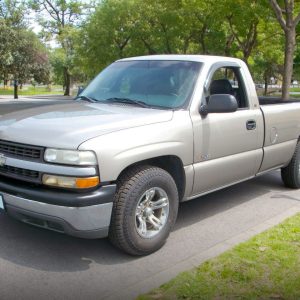
After purchasing this ’02 Silverado, the owner was looking to gain some additional horsepower and torque through a few small bolt-on performance parts. While the truck is still under warranty, there is a large variety of performance parts that not only meet certain warranty requirements, but also do not cause any problems at the dealership. After looking at all the available options for this Silverado, it was decided that the first modification to the engine was going to be the addition of a new AEM Brute Force air intake. AEM offers a vast array of dyno-proven intakes for specific applications, including trucks such as this Silverado.

Spotlighter
POPULAR READS
-
The Auto Builder’s Hottest Product Picks from The Triple Crown of Rodding 2026
-
Product Spotlight: Bill Mitchell Products Aluminum LS Engine Block
-
PRODUCT SPOTLIGHT: 60-66 Chevy C10 Fresh Air Vent Block Off Plate
-
Product Spotlight: Pyramid Optimized Design Sequential Aurora Taillight for 1964½–1966 Mustang
SQUIRT GUN
WATER INJECTION FOR YOUR POWER-THIRSTY ENGINE
Author
Sean Greene
Photography by Nick Chin
Why water? If you read HCI’s intercooler article in the April ’04 issue (“Chill Out,” p. 131), you know that water has a large capacity to retain heat. So when water is introduced into a hot environment, a percentage of heat is absorbed. This is effective when installed on an internal combustion engine, especially when it’s supercharged or turbocharged.
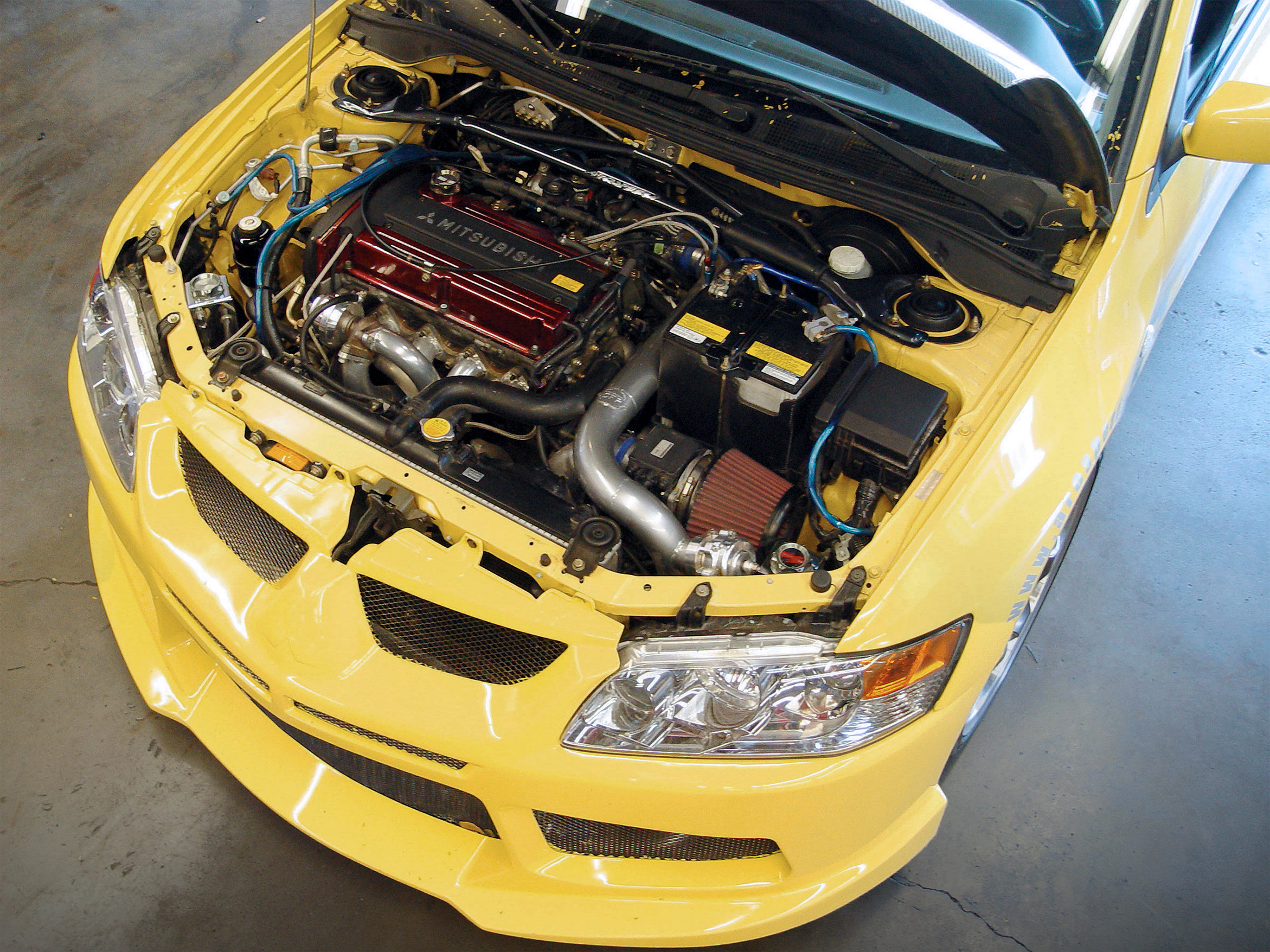
South Florida Performance (SFP) installed the Aquamist System 2s, which comes with a controller that is capable of adjusting the system at different rpms (2,000-9,000). It’s adjustable in 1,000rpm increments and has the option of 3D mapping when used with a MAP sensor. The owner of this ’03 Mitsubishi EVO VIII has intentions of pushing the envelope and eventually installing standalone engine management, so he wanted a system that would be fairly flexible.
The Aquamist system isn’t a power-adder like nitrous oxide, so if you are expecting to see a direct increase in power after installing this product you will be disappointed. However, your engine will be able to make more power because of it. Confused? Remember that water is being injected to help suppress the chances of detonation and with less detonation, you can turn the boost up higher or run more timing. Naturally, if you have access to good gas like 94 octane, you will be able to run more boost than someone will on 92 octane; but with the Aquamist you can squeeze out even more power.
It should be noted that the Aquamist system isn’t a substitute for an intercooler, but more like an add-on. Imagine combining this product with an intercooler and intercooler chiller such as the Nitrous Express N-tercooler. To increase the effectiveness of the Aquamist system, SFP opted to use a fifty-fifty mixture of methanol and water. Methanol has an octane rating of 113 that will increase the fuel quality and the cooling capacity of the water.
This product works on a wide variety of vehicles, both naturally aspirated and force-fed. The system will help reduce detonation; however, if your engine is detonating before you purchase this product, you should put your money into solving the problem first. The Aquamist will not make existing problems disappear.
ARTICLE SOURCES
Aquamist
440 Rutherford St.
Goleta, CA 93117
(888) 888-4079
South Florida Performance
18728 SW 107 Ave.
Miami, FL 33157
(305) 233-8520