







THE AUTO BUILDER
Menu
Featured
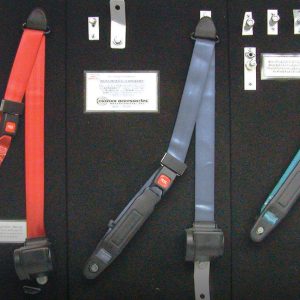
Installing a Custom Accessories Three-Point Harness System
This is the problem in a nutshell: When we are traveling in an automobile, it may seem that we personally are not moving, only the car is. But that is not the case. If the vehicle that we are traveling in happens to stop suddenly, we won’t, unless … there is something there to stop us. That something could be a seatbelt—or it could be something less desirable.
The cold hard fact is that injuries can be suffered during an auto accident. Injuries such as those sustained by the face and head as a result of being thrown into the windshield or dash. Or it could mean those nasty abdominal injuries due to contact with the steering wheel. Either way, it doesn’t sound like much fun. They can also be prevented.
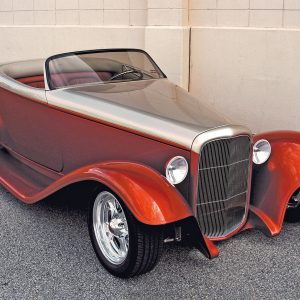
MAKING A GOOD THING BETTER
It’s a simple concept really. You see, when you build six-figure cars for one person, many others stand by and wish they, too, could have such a fine piece of work. Of course, all that one-off bodywork, tube frame construction and sculpted interior is just too pricey for most street rodders, and that doesn’t even consider the price of an artist concept study and subsequent drawings.
However, after spending all that time, money and effort to produce an aesthetically pleasing and award-winning design based on the venerable ’32 Ford, why not mass produce the car in fiberglass with the same great chassis and super smooth lines? That thought crossed Boyd Coddington’s mind when he did the original Boydster, a fenderless highboy roadster. The next progression was to add fenders to the car and so, being a sequential kind of guy and is good with numbers, Boyd decided to call this one the Boydster II. The car embodied all the great style of the first car, but now with fenders.
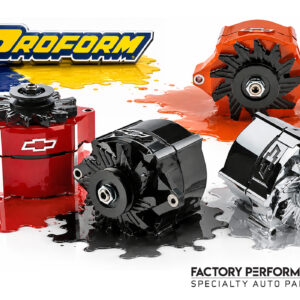
PRODUCT SPOTLIGHT: SHOW YOUR COLORS WITH PROFORM
You can spend a small fortune making an engine compartment look right, but one parts-store alternator can kill the whole vibe. That plain aluminum lump might get the job done, but it certainly isn’t winning any points when the hood goes up.



Spotlighter
POPULAR READS
-
The Auto Builder’s Hottest Product Picks from The Triple Crown of Rodding 2026
-
Product Spotlight: Bill Mitchell Products Aluminum LS Engine Block
-
PRODUCT SPOTLIGHT: 60-66 Chevy C10 Fresh Air Vent Block Off Plate
-
Product Spotlight: Pyramid Optimized Design Sequential Aurora Taillight for 1964½–1966 Mustang
GOLDEN ARCHES
How to Fit Larger Tires by Stretching Existing Wheel Arches Without Using Special Tools
As enthusiasts, when we build our cars, we tend to stuff as much tire under those cars as possible. This is especially important for rear tires that hook the car to the ground while improving its stance. For those interested in drag-racing their cars, you will need to accommodate larger rear tires or slicks. The current hot trend is the 10.5-inch slick, which seems to work well on many applications, but depending on the make and model of your car, it may require modifications to enlarge the rear wheel openings to accommodate the larger rubber.
Author

Tommy Lee Byrd
Words & Photography
The Project: Opel GT with Twin-Turbo Small-Block Chevy
Although not a popular car because they are rare, the example here is an early-’70s Opel GT, powered by a twin-turbocharged small-block Chevy. To hook up this monster, owner Ernie Lankford commissioned Tim Dixon to build a tubular chassis and bolted the body to the new chassis. Although the chassis was done and built to fit more than a 10.5-inch tire, the body was not, so it required rear wheel-well modification for overall tire clearance.
A Universal Approach to Wheel Well Mods
Forgetting our example is an Opel, these modifications can just as easily be done on almost any muscle car, with or without a full chassis. Regardless of the car you are modifying, the process here will show you the basic steps using no special metalworking tools. In this case, the 10.5-inch tires would fit just fine once clearance is provided for the overall diameter of the tire, which was too large for the stock wheel arches.
Wheel Arch Customization Options
Some wheel-arch or stretching mods may be a whole lot simpler than those shown here, while others may require that you build a whole new inner wheel structure. If that’s the case, simple wheel tub kits are readily available for that purpose, or you can build your own in much the same way that you enlarge the wheel wells.
Repairing Rusted Lower Panels
If you need lower panel repair work on your car—which was the case with this project, which had badly rusted lower panels—those panels are easily replaced with new ones that will form the new wheel openings. In this case, we chose a subtle route and simply pie-cut the lip in the lower portion of the quarter panel where the fender tucks under. That may differ from your application, as every car will have its own unique wheel-arch characteristics.
Challenges of the Build
This project proved to be a little more difficult than we first imagined because the wheel lip was round, and shaping round from flat sheet stock is not simple. In addition, the rusted areas left nothing to build from. The modifications worked out nicely, while taking on an unaltered look, which was the plan from the outset. Now the wheel arches accommodate the larger 28×10.5-inch tires, and after they are painted, they will give the car a great look.
Final Thoughts
Follow along to see how these wheel arches were stretched, and how this may apply to your own project. This is not rocket science, just a lot of work. As you will see, although they would be helpful, you don’t need special metalworking tools to complete this work. If you do have access to metalworking tools, though, use them, as they will no doubt necessitate less finish work. Check out this project and see if it can help you in the event you need to enlarge your rear wheel wells.
1. While we’re using an original Opel GT body that has been placed over a tubular chassis, it might as well be any car. These mods illustrate that such an approach can work on most any application. As you could well find on any older muscle car, this body was rusted away at the bottom of the wheel arches, which required replacement anyway.
2. While at the chassis shop, the quarter panels were cut slightly to fit the larger tire and wheel. Now the wheel arch requires a new, larger radius, while retaining the original look. For this car, that will be done by pie-cutting the lip, which will provide a softer curve to the arch. Yours may require reshaping, depending on what you are working with going in.
3. An electric cutoff wheel was used to remove the rusted-out metal on the lower portion of the quarter panel. After you have established your basic measurement requirements, remove the tire and wheel to allow adequate room to work.
4. A vertical cut was made, staying at least 1/2 inch away from the panel edge, or seam, where the quarter panel meets the rocker panel. This area is smoothed with lead from the factory, so you will need to grind or heat the lead before you can begin welding.
5. The edges were then cleaned with a small angle grinder. Make sure all the paint and underlying primer is removed so that your welds will be clean and strong.
6. The panel was marked just past the existing roll in the lip so the correct contour would be maintained. Also note that the line is thicker at the bottom to show how much material will be removed to widen the arch. If you are changing the shape of the wheel opening, here is where you will do it.
7. Again, the electric grinder with a cutoff wheel attached was used to cut through the stock panel. Simply follow the lines and it will cut with ease.
8. When the panel requires a smaller cut, use an air-powered saw or a smaller cutoff wheel, as the larger cutoff wheel may be too large for the curve. This will ensure greater accuracy and a finer cut. Here, the fender was cut across the roll to completely remove the lower portion of the arch. Since your wheel well may differ, cut and adjust your technique accordingly.
9. Using an air-powered grinder, smooth the cut metal until there is no trace of the irregular cut marks. Do this by clamping the metal in a vise, or use a pair of flange-face Vise-Grips to hold the material.
10. As shown here, shape the piece to your liking, grinding as necessary. Here, the rolled lip was clamped back in place using flange-face Vise-Grips. Check the gaps and ensure the piece is aligned with the panel and then double-check the measurement to see how much you moved the lip. With a simple tack weld, it’s a good idea to test the tire to ensure you’ve achieved the required clearance.
11. With the reshaped metal clamped in place, make sure it looks good and it’s where it needs be. If a little more clearance is needed, make another cut. As shown here, the clamped piece curved too tightly, so another cut was needed to soften the curvature and provide more tire clearance.
12. Using a marking pen, make your marks before removing the panel, as it will be difficult to remember exactly where the cut should be. Even though you figured it out, mark it before you get back to the workbench, because it’s easier to remove material than replace it. For this cut, the lip was eyeballed to identify the harshest point in the curve, and it was marked from there.
13. With the panel removed and clamped with Vise-Grips, the cut was made. You may prefer to use a pie cut—where the metal is sliced but not totally removed. That will work for many applications, but to make this quarter panel lip more uniform, the lower portion of the piece was completely removed to fit.
14. With the lower piece removed, the upper portion was reclamped in a better position to the quarter panel. Now place the lower piece under the quarter panel and twist it counterclockwise until the wheel arch shape is exactly as you want it. Then simply mark the metal and make the cuts.
15. After cutting and grinding, use whatever Vise-Grip clamps necessary to position and secure the upper portion to the quarter panel while making the arch. Step back and check that the arc of the curve is smooth and uniform all the way through. If not, it will show.
16. Tack-weld the two reshaped panels to the quarter panel. With a good spot weld in each corner, remove the clamps and check to see if any minor adjustments are necessary before final-welding the panels in place. This is the time to make any necessary final adjustments.
17. Don’t expect beautiful, perfect welds with this kind of project. You only need to spot it here and there so that you can keep going back over the panel, keeping heat to a minimum. Otherwise you will badly warp the panel. Remember, too, the grinder will cause heat buildup.
18. Here’s the finished upper portion of the enlarged wheel arch. So far it’s looking good, but the lower portion will be more difficult because there is no solid starting point. In that case, you need to start from scratch with new sheetmetal.
19. Begin by making the easiest panel first. The panel for this car does not include the more difficult compound curves, making it easier to fit. Mark the new panel according to the cuts you made previously, leaving plenty of additional material at the bottom to tie the new panel into the chassis structure.
20. After rough-cutting the patch panel, it was clamped in place and marked for the bend required to match the lower lip. Without a metal brake, clamp the panel in a vise and hammer the lip to form the roughly 90-degree bend, making the slight roll by hand to match the existing quarter panel.
21. Though the inner structure has surface rust, it will act as a guide for the slight roll of the repair panel. The wedge-shaped inner structure will allow you to hammer the excess steel all the way around and then weld it to the rectangular tubing that ties directly into the chassis.
22. As with the upper fill panel, tack-weld the lower panel in place, checking for panel fitment before fully welding it in place. When most of the welding is complete on the outside, carefully hammer the lower lip in place and weld it securely.
23. When the new panel is fully welded, use the electric grinder to smooth the welds. Then run a few passes using the small angle grinder to remove any harsh grinding marks and to make a smooth transition.
24. This step was the toughest part of this project. The lower lip was made from flat stock without any specialized metalworking tools, which proves that it can be done. The bends and curves were made using a vise, hammer and dolly, which is about as basic as you can get.
25. After cutting the piece to size, it was placed in a bench vise and bent 90 degrees. Then a hammer and dolly was used to make the compound curve, which was no easy task. A simpler way to fabricate this lip would be to use a shrinker/stretcher tool. Although not terribly expensive, this is not a tool you would generally find in a home shop.
26. Lots of work with the hammer and dolly eventually resulted in the satisfactory panel you see here welded in. Any small imperfections will be smoothed with body filler.
27. With the front portion of the wheel arch complete, you can look at the entire quarter panel to see how the area behind the arch should be shaped. The rusted panel means that an entire lower rear section will need to be fabricated from scratch, which should not be a problem.
28-29. While not pretty, this is what we had to work with. The rusted panel to be removed was marked beyond the rust and cut out with the electric grinder. When removing the vertical portion, leave at least 1/2 inch of material from the corner so you have a nice, flat area to which to butt the new metal.
28-29. While not pretty, this is what we had to work with. The rusted panel to be removed was marked beyond the rust and cut out with the electric grinder. When removing the vertical portion, leave at least 1/2 inch of material from the corner so you have a nice, flat area to which to butt the new metal.
30. With the rust area cut away, you can finalize your repair plan. With surface curves, bends and twists, the shape makes this panel of the wheel arch difficult to make, especially with limited tools and no English wheel. It will take several small pieces to form the overall desired shape.
31. Start with the flattest panel and fabricate a patch. Cut a piece of steel panel to roughly match the size and shape of the original and clamp it into place. There are still several cuts and bends that need to be made, but the upper portion fits nicely.
32. Next, go to the inside of the panel and mark where the cuts need to be made to form the shape. You can do this by making a rough outline where the panel would meet the rolled lip and cut it oversize, as it will be trimmed to fit later. By making it oversize, you don’t need to be extremely precise.
33. The trimmed, shaped and curved panel was clamped in place and inspected for final fit before it was welded. The joint between the new panel and the existing panel was tricky to get perfect, but it worked out fine and is ready to weld.
34. After it was tack-welded, the clamps were removed and a hammer and dolly was used to flatten and final-shape the panel contour. At this point, remove any imperfections.
35. The lower panel is tack-welded in place. Now the new upper section, with its rolled lip, can be fabricated. Since the rear quarter on this project was rusted up to this point, the replacement panel needs to be built from scratch.
36. Okay, we know it may look crude, but it will work, and it will look good when it’s finished. The upper formed lip was tacked in place and joined with the lower segment. It will take a little grinding to smooth, and the panel will be filled, but with limited tools, this was the simplest way to make the new stretched lip—out of smaller sections set at different angles. Note the lip shape is smooth and flowing.
37. In our case, we filled in the gap with a small piece of sheetmetal and built the rest of the 90-degree lip in one piece of metal. After initial-welding it in place, grind the welds flat and fill in any pinholes or gaps.
38. After the gaps were filled and welded, it was simply a matter of grinding down all the welds and ensuring there were no remaining holes.
39. Once the new panels meet your final approval, finish the surface using the air-powered angle grinder to smooth the steel and prepare it for body filler. Blow off the dust and use a wire brush to clean any pits left over from the welding. Then apply a skim coat of body filler, shaping as you go.
40. Here you go, ready for bodywork. Step back and admire your efforts, because if you haven’t done so, you need to duplicate this on the other side! The job turned out fine, and the new wheel arches now offer plenty of tire clearance.
41. Here’s what we were after, and what you can accomplish on almost any car. Simply analyze all the fitment issues and then modify the wheel wells and outer lip to fit. Fitment here is so good, you’d never know the wheel arches were modified to the extent they were, especially considering that the bodywork has yet to be done.
42. And that takes us to the final finishing. Apply a skim coat of body filler to the entire area and block-sand with a flexible long board. This allows you to sand heavily contoured areas to perfection. The first cut is done using 80-grit paper, which will eventually be followed with 180-grit fine paper before primer.
43. The car was wiped down with wax and grease remover before high-build urethane primer was applied. The tire and wheel were removed to access the inner quarter panels. After the primer, a guidecoat was lightly applied, which allows you to find low spots and to sand or fill those imperfections accordingly.
44. When the bodywork was completely finished, a fresh coat of paint was applied. It looks good and will look even better once the paint is color-sanded and buffed to a high luster.


