







E-BODY MOPAR AIRBAR
If you lived during the muscle car era or have any experience with the E-body Mopars—’Cudas and Challengers—then you understand that these were factory rocket ships that were pure excitement to drive. Perhaps you recall those Plum Crazy 340 six-pack ’Cudas and 440 six-pack Challengers—they were hot back then, and they’re even hotter to own now.
How to Choose a Camshaft
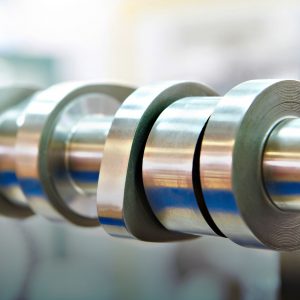
Would you believe that one of these cams could provide an extra 200 hp to your combination? It’s true. Actually, the truth is that the installation of a stock cam will cost you as much as 200 hp.

CANDY COUPE
It all started when Jacky White found a basket case ’32 Chevrolet coupe. The old Chevy may have come home in pieces, but at least the pieces were very good. The coupe was complete, and for a 70-year-old body, it was in excellent condition. After getting all of the pieces back to his home shop, a quick inventory indicated that the car was complete, from the cowl lights and bumpers to all four steel fenders. In short, Jacky White had everything he needed to build a ’32 Chevy street rod.




A Love for Classic Vehicles
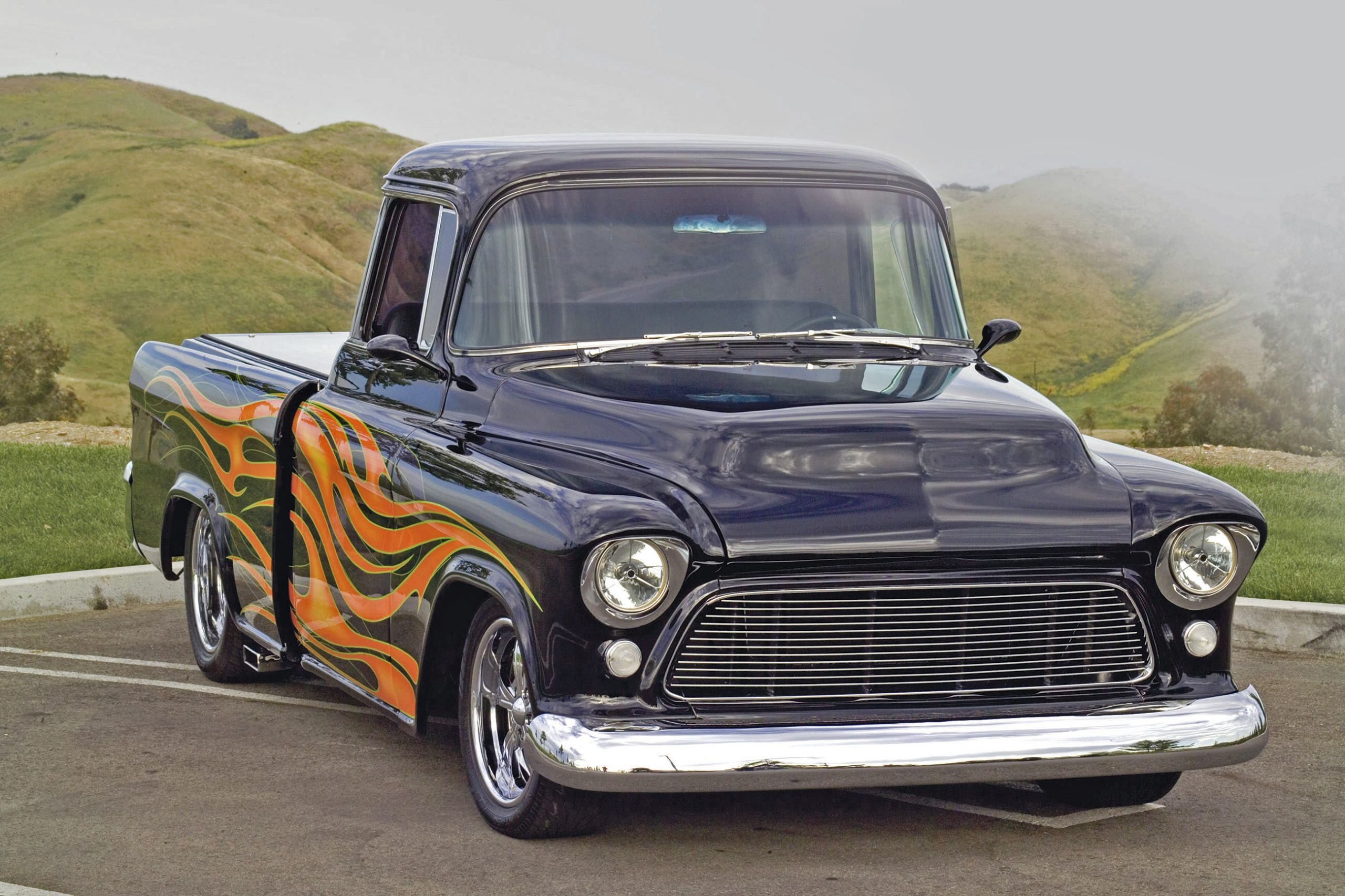
Gil Palmer just loves cars, trucks, and motorcycles. He’s owned more than 100 miscellaneous cars, ranging from ’40 Fords to ’55 Chevys to a ’70 Monte Carlo. He’s owned a few pickups, too, and this one originally came to him as the bonus gift, so to speak, in a trade of his ’32 Ford Cobo Hall winner for a motorcycle at the Detroit Autorama. The ’57 Cameo that he received in the trade had an entire ’55 front end on it, and because of that, everyone thinks it’s a ’55. But this truck was in pretty sad shape when it arrived at Palmer’s Southern California home. Just picture this one item in your mind for a minute, and you’ll get the gist of the kind of shape the truck was in: There was a hand-painted (we’re talking 4-inch-wide brush, here) Chevy Bow Tie on the tailgate. The 10:1 compression supercharged engine would overheat in a matter of a few blocks.
The Decision to Rebuild
Despite the hideous condition of the truck, there were rumors that it had originally been built by Boyd Coddington (though Palmer was never able to confirm this), so he thought it was at least worth redoing. After a few Band Aid-type fixes, Palmer decided it was time to completely redo the truck. He took it to Terry Belzenye, a car builder of note for some 40 years at Specialized Street Rods in Huntington Beach, California, and also a personal friend. Over the next 12 months, Belzenye and Palmer completely rebuilt the truck and turned it into a show winner and head turner.
 Frame and Suspension Upgrades
The stock frame was modified by Specialized to accommodate a Volaré front clip and to handle the power of a blown 383 Chevy engine. The Volaré (out of a ’67 wagon) was positioned to drop the truck 5 inches and came with disc brakes and power rack-and-pinion steering. A custom remote power-steering unit was used, and the custom-designed brake system features a vacuum brake tank. Specialized added a set of Fatman dropped spindles and then mounted 17-inch Intro chrome wheels and Nitto 225/60-17 tires. The rearend is a Ford 9-inch with 4.11 gears and a Detroit Locker Softlock connected to Alston ladder bars. Rear wheels are also 17-inch Intros (by the way, they are chromed on both sides) with 275/50-17 Nitto tires.
Engine: Power and Precision
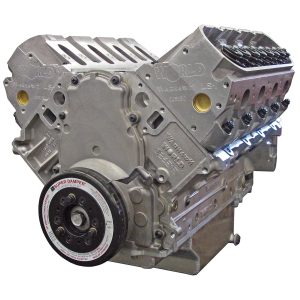
Dropped between the framerails is a 383 stroker Chevy engine with a big Mooneyham and Sharp 6:71 blower built by one of the most famous hot rod shops of all time, Blair’s Speed Shop in Pasadena, California. To handle the estimated 700 hp, Blair’s used a steel Eagle stroker crank and H-Beam steel Eagle rods. Pistons are custom Ross units with Xtreme rings. Aluminum heads with a custom valve job contribute to the low 8:1 compression ratio that’s needed for this big-boost combination. A Comp Cams camshaft (0.515 lift with 248/257 duration) is driven by a gear drive. Two Holley 650 double-pumpers supply the air/fuel mixture. Street & Performance’s serpentine belt system was used, and it even drives the Vintage Air air-conditioning system. A custom-machined air cleaner is complemented by black Chevy valve covers and a Milodon oil pan. Tom Dawson built a set of headers, and Flowmaster mufflers were used. Electric cutouts from Doug’s Headers allow for uncorked cruising where applicable. Art Carr’s California Performance Transmissions custom-built the gate-shifter-controlled transmission and used a 3,000-stall-speed converter. A B&M transmission cooler keeps things at operating temperature. Gil also had a Gear Vendors under/overdrive installed so he could cruise, despite the 4.11 gears. This engine and drivetrain combination was built to be powerful but manageable on the street. There’s no more overheating worries, and maybe the custom-made radiator from Mattson’s in Stanton, California, is part of the reason.
Body Modifications and Paint
Nothing wild was done with the body, but a few nice touches by Specialized Street Rods cleaned it up. First, the driprails were removed, and that’s no easy task. Then the doors were radiused, the reverse-opening hood was bolted on, a billet grille was installed, and a custom core support was fabricated. They filled the body, built a smooth firewall, custom-fabbed inner fenders, and added a third brake light. Jag-style headlights were mounted inside the ’55 buckets. The bed floor was built with solid oak, and a Gaylord’s custom bed cover keeps it protected.
A Flawless Finish
The body was not actually in awful shape, so you’d think the guys at Autocrafters in Torrance, California, wouldn’t have all that much to do, but since Gil wanted the base color of the truck to be black, they had to make sure that everything was absolutely perfect. We can attest after several hours of poring over this truck that it is, in fact, perfect. You can thank master painter Rick Leos for the wild custom flames.
Interior: Custom and Comfortable
For the interior, Gil turned to Fiber Tech in Huntington Beach, California, and they used BMW ultra-soft leather in black for the seats and custom-made a headliner that’s very cool. A Flaming River steering column was topped with a Flaming River steering wheel. The dash was customized by Specialized Street Rods, and a bevy of Auto Meter gauges was installed. The wiring was completely redone with all connections soldered for ultimate reliability. What about the stereo, you ask? Get real, you couldn’t hear anything with the engine running anyway, so Gil didn’t even bother. Besides, that Mooneyham and Sharp blower is enough music for Gil’s ears. And if he’s really in the mood for music, his ’04 Chevy Silverado (click here to read the article) has it covered.


