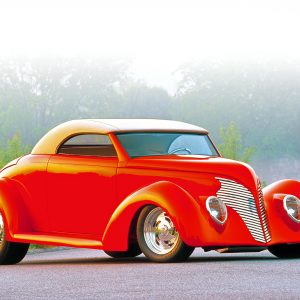
A Carpet Deal Leads to a Hot Rod Build
“It all started with my buddy Dave Collins, a flooring contractor who happened to own a ’55 DeSoto sedan, complete with terminal rust. I told him I would be interested in buying the engine,” says Jim Moore, owner of this roadster. “He replied that if I would buy the entire car, he would sell me new carpet for cost plus five percent; this enabled me to haul the DeSoto hulk home and part it out without any complaints from my wife as she gained new carpet in the deal.” And so it goes in the world of hot rodding!
Building the DeSoto Engine: From Rust to Roaring
Jim had no problem doing it his way as he built the DeSoto engine, boring it 0.030 over the original 291. While the crank and rods remained stock items, Egge 7.5:1-compression pistons were installed, as well as an Isky 280 camshaft with 0.485 lift and 280 degrees duration. Dave Mussel of Midstate Machine in Santa Maria, California, performed the machining and balancing, and Art Foster, also of Santa Maria, completed the engine assembly.
Sourcing the Weiand 4×2 Manifold and Customizing the Setup
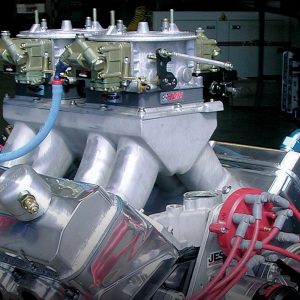
There isn’t a great assortment of aftermarket intake manifolds offered for the DeSoto Hemi, so it took Jim more than a year of searching and scouring Hemmings motors to come up with a Weiand 4×2 manifold, which he fitted with vintage Stromberg 97s. These were rebuilt and set up by legendary Flathead builder Warren “Hoke” Hokinson, who set them up to run all the time with no progressive linkage. A Mopar electronic ignition provides the spark while cooling is handled by an aluminum Chevrolet water pump and Hot Heads adapter. The headers are by Sanderson and exit to 18-inch glass packs. Horsepower is estimated at 250, which actually seems a bit conservative.
Creating a Barebones ’32 Highboy: Chassis and Body Work
With the engine complete, Jim gave some thought to a barebones ’32 highboy—something without a hood—so that the rare engine could be seen. He promptly ordered a TCI Stage III chassis and Wescott’s body. Once everything was in the shop, Jim was assisted by Randy Mathews of Mathews Fabrication (Nipomo, California) to begin work on the chassis, fabricating mounts and brackets as needed. TCI had already C’d the frame in front and rear for axle clearance and installed the brackets for the clutch linkage.
Transmission and Rearend: Powering the Highboy
Jim chose to utilize a Saginaw four-speed with a GM clutch hooked to the DeSoto with an adapter and flywheel provided by Pat McGuire at Wilcap Products in Pismo Beach, California. The Hurst shifter handles gear selection with ease, and the rearend is the desirable Ford 9-inch hung via coilover shocks. The dropped I-beam front axle is mounted with hairpins and runs disc brakes and Vega cross steering, which was all part of the package from TCI. The Wheel Vintiques Gennies and the grille insert have been powdercoated in a bright red, which is a nice highlight to the understated gray body and chassis.
Finishing Touches: Body, Paint, and Interior
Charlie Hemstreet, also from Nipomo, stepped in to prepare the body and spray for the gray acrylic enamel coating. Steve Havens pinstriped the highboy in a traditional style. When it was time to select lighting, Jim kept the traditional look going with ’39 Ford teardrop taillights and Dietz headlights. Richard Enos restored the original ’32 license plates.
Jim narrowed a ’40 Mercury dash to fit the roadster, using Stewart Warner Wings gauges in an aluminum panel of unknown origin that was given to him by a neighbor. The steering wheel is a ’40 Ford Standard item, and the seat is from an Isuzu pickup and was narrowed to fit. Don Wray of San Luis Auto Interiors in San Luis Obispo, California, trimmed the interior in red vinyl and the trunk in matching red carpet.
Honoring Hot Rodding History: Plaques and Timing Tags
Now, regarding the question you’re all asking, we again went to Jim, who related to us, “The reason for the plaques…well, I wanted to recognize the historical significance of the early hot rodders and where it all began, which was at the dry lakes. In order to be allowed to run at Muroc or El Mirage, the guys had to belong to a car club affiliated with SCTA, Russetta, or Mojave (there were several other short-lived associations that put on events as well). Each of the plaques represents a club that ran at the dry lakes, though there were dozens of others as well, some of which never had plaques.”
The Significance of the Timing Tags
As to the timing tags on the firewall, “They serve the same purpose, and though the tags are reproductions, the data engraved on them is factual, containing the names, times, and dates of actual participants going back to the ’40s. It was not my intention to display them as if they were earned by my roadster, but rather to honor those responsible for hot rodding,” he says. Jim had first gone to Bonneville with the Firestone Tire and Rubber Company in 1953, the fourth year that SCTA ran there, and he has been back four times since 2000.
A Conversation Piece: The DeSoto-Powered Roadster
So there you have it, a story of a retired geezer who built what he wanted and is happy to share it. Again, in his own words, “I wanted to showcase this unusual engine and as a result, this conversation piece engine has enabled me to meet and make many new hot rod friends. I recently picked up a ’52 Cadillac engine hoping to build a second conversation piece roadster.” We’ll keep you posted on how that one turns out.