The Rise of a Racing Legend
Dick Harrell represented the Chevrolet marque from day one as he started drag racing in the amateur ranks, and by 1961, he had racked up impressive credentials, winning 90 percent of the races he entered that year and every race in a three-state area of the Southwest.
Harrell’s success continued into the pro classes, where his consistent performances earned him the NHRA points championship in Super Stock in 1962. By 1963, with factory-backed competitors all around, Harrell impressed the racing world by continuing to win, and in 1964, he downsized to a 427-powered Chevelle as others moved to smaller cars.
Staying Loyal to Chevrolet
In 1965, when Chevrolet pulled out of racing, many drivers switched brands. However, Harrell remained loyal, and despite going it alone without factory support, he continued to win races against competitors backed by major manufacturers.
Creating a Special Breed of Cars
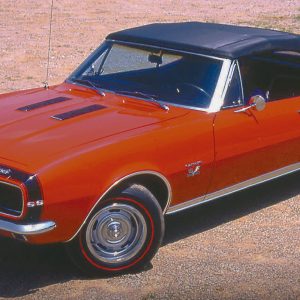
In the midst of his drag racing success, Harrell was approached by Nicky Chevrolet in Chicago to create special high-performance cars. One of the first cars Harrell built for Nicky was thought to be the first 1967 Camaro fitted with a 427 Chevy engine, setting the standard for Nicky Chevrolet builds. His talents were later brought to Yenko Chevrolet, where Harrell worked his magic on more Chevys, building a reputation for high-powered cars.
Contributions to Chevrolet’s Muscle Car Legacy
Harrell’s engineering prowess extended to Fred Gibb Chevrolet in Illinois, where he worked on Chevelles, Novas, and Camaros. His contributions to muscle car development also included the ZL-1 all-aluminum 427 engine, a game-changer for both street and track cars, including the Can Am series.
Honoring Harrell’s Legacy Through the Dick Harrell Edition Camaro
Though Harrell tragically died in a racing accident in 1971, his legacy lives on through modern interpretations of his classic creations. One such homage is the Dick Harrell Edition Camaro, built by GMMG Inc. in Marietta, Georgia. This special series of cars, including one owned by Harrell’s daughter Valerie, pays tribute to Harrell’s innovations in muscle car design.
The Dick Harrell Edition Camaro features an impressive 652 hp and 624 lb-ft of torque, courtesy of a bored and stroked 427ci racing block, a Callies crankshaft, Oliver rods, and JE Pistons. A special Comp Cams grind ensures maximum power, while a NASCAR-inspired exhaust system with electric cutouts amplifies both sound and performance.
A Modern Classic with Unmistakable Power
The car is equipped with a T56 transmission, a Z06 Corvette clutch assembly, and a Hurst Line-Loc shifter, while a Strange 12-bolt rear axle with a 4.11:1 ratio and Positraction ensures power reaches the pavement. Eibach springs, Koni shocks, and Z06 Corvette brakes round out the performance upgrades, while Michelin Pilot tires mounted on Fikse 18-inch rims provide serious grip.
Distinctive Styling and a Nod to the Past
The wide-body kit, inspired by GM’s Penske Donahue Woodward Dream Cruise Camaro, gives the car a bold stance. A stunning Butterscotch Pearl and Tangerine paint job by Bill Carter, along with Dick Harrell’s signature stripes and badging, make this car unmistakable. Inside, special edition silver-faced gauges, headrests, and floormats emblazoned with the Dick Harrell logo remind drivers of the car’s historical significance.
Continuing a Racing Tradition
The Dick Harrell Edition Camaro is not just a car—it’s a tribute to the legacy of one of drag racing’s pioneers. While Harrell himself may be gone, his contributions to the world of high-performance cars continue to inspire enthusiasts and collectors. With limited production numbers, these cars are set to become automotive investments, just like the original Chevrolets Harrell built decades ago.
As Harrell’s daughter Valerie and her partner Dale Pulde continue to champion this project, enthusiasts like Vic Edelbrock and Dale Earnhardt Jr. have already joined in, securing their own pieces of automotive history. If you’re lucky enough to get your hands on one of these rare Camaros, you’re not just buying a car—you’re buying into a legacy.