





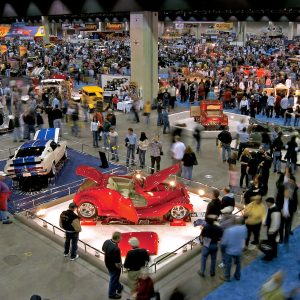
REVVIN’ UP AT THE ’07 AUTORAMA
Regardless of our residential location, there seems to be a specific show that we just can’t stand to miss. It’s a show we anticipate all year long, and we can’t imagine a season without attending it. It certainly isn’t the city it is held in that’s alluring; it’s the quality of the cars that show up, and there are always a few surprises, as builders spend millions of dollars competing for the prestige of winning the coveted Ridler Award.
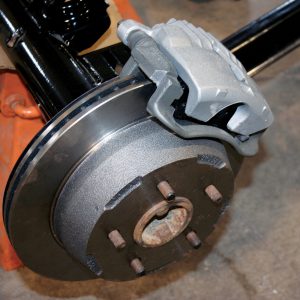
Scrap Yard Binders
Since we don’t really have to search for vintage parts anymore, gone are the days of scouring the local “Pick-a-Part” in search for that illusive part that will interchange or convert your muscle car to bucket seats, tilt steering, A/C or some suspension upgrade. But there was a day when you and a rodding buddy could venture to your favorite junkyard and come home with a whole truckload of cool vintage goodies that would aid you in your rebuild, all in the span of a day.
Well, those days aren’t completely gone. While at the local wrecking yard looking for any useful hot rod parts, we stumbled across another enthusiast, Sean Rievley, who is in the progress of upgrading his ’71 Chevelle chassis
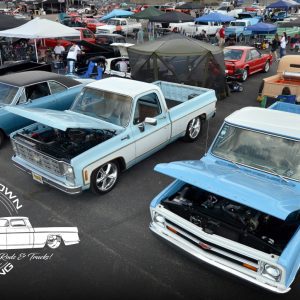
Truck Triumphs at the Triple Crown of Rodding 2023
In the world of rodding and customization, there are certain moments that stand out as big achievements—proof of how dedicated, creative, and skilled the builders can be. The first Triple Crown of Rodding show in 2023 is one of those moments, a big success that everyone in the car world will remember. It was organized by industry juggernauts, Bobby Alloway and Gary Case, and it brought together some of the best builders in the business, like Roy Brizio, Art Morrison, Troy Trepanier, Chip Foose, and Alan Johnson just to name a few! Car fans from all over the country came to the Nashville Superspeedway to celebrate car craftsmanship and meet the people who made these amazing cars.




Hot Rod Magazine and a Cultural Spark
The coupe began its climb to fame when it graced the cover of Hot Rod magazine in July 1961. While the car had been an ongoing project for several years before then, the cover shot by Eric Rickman launched this hot rod into the immortal zone. Legend has it that The Beach Boys saw the car on the cover of Hot Rod and said that was the car they wanted to use on the group’s new album, “Little Deuce Coupe,” and the rest, as they say, is history. So let’s take a brief look at that history.
Chili Catallo’s Early Hot Rod
Clarence “Chili” Catallo originally purchased the ’32 coupe for $75 in 1956. The 16-year-old Catallo had the coupe on the road in 1957, and by 1958, the coupe was seeing drag-race duty, too. The best time for the car was 12.90 and 112 mph. That’s mighty quick for 1959! Power for the coupe came in the form of a ’56 Oldsmobile that displaced 344 ci. Jahns blower pistons were wrapped with Grant rings. The heads were filled with Chrysler intake and GMC truck exhaust valves, and a Clay Smith cam completed the valvetrain. A 6-71 blower was mounted atop these heads, and a Cragar short-drive was employed. This blower eliminated the room for the stock water pump, so an electric water pump from Jabsco was mounted to the front crossmember. A stock Oldsmobile clutch hooked the power to a ’37 LaSalle three-speed tranny, which turned the gears in the big, chromeplated ’55 Olds rear-axle assembly. By 1959 standards, this driveline was both powerful and bulletproof. The front axle was a tubular unit from a ’37 Ford, mounted using split wishbones, Monroe shocks and super-rare Kinmont disc brakes. The entire front suspension was chromeplated.
Show Circuit Arrival
The car rolled into its first show in 1959. During our research on this car, Bob Reynolds, now of the National Street Rod Association, said, “I remember first seeing the car in the Detroit Autorama in 1959. There were bubbletop show cars everywhere, and Chili’s coupe was there, too. It was a great car.” The famous Alexander Brothers had worked their metal magic on the nose of the coupe, forming a grille and headlight housing that still looks great today. The shape of the grille opening is similar to that of a stock Deuce, but the quad headlights and expanded metal grille with distinctive horizontal bars made the nose contemporary for its day. Out back, a special rolled rear pan incorporated horizontal tubing and custom-made plastic taillights and featured tubing over the taillights, too. The rear pan continued the contemporary theme on the car.
Radical Proportions
The overall profile of the car was substantially lowered (a whopping 15 inches lower than a stock Deuce body). This height reduction was achieved by channeling the car 6 inches, sectioning the body 6 inches and finally chopping the top 3 inches. An interesting body modification was the raising of the door bottoms. Actually, the lower portion of the body was trimmed off and the bottoms of the doors were raised to their original position, even with the top of the framerail. The Alexander Brothers then filled the area below the doors with three pieces of sculpted aluminum. These aluminum panels suggest a modern version of the running board and do a fine job of filling the void under the body. The other noticeable feature of raising the bottom of the doors is that when the door is open, the floor is totally flat, with no big step up to the floor, which is typical of deeply ºchanneled cars. The result of all these body modifications is a Deuce of perfect proportions.
Barris Association and the Truth
Part of the “legend” of this car is that it was built by George Barris. This part of the legend is due in no small part to the Barris crest affixed to the cowl of the car. Actually, the Alexander Brothers did the bulk of the body modifications. Then, in 1960, Catallo went to work at the Barris shop for a short time. While there, he chopped the top on his own car, and Barris sprayed the Oriental Blue metallic with pearl-white scallops. The workmanship and overall panel fit on the car were extraordinary for the time.
Inside the Coupe
On the inside of the little coupe, the bucket seats were fabricated and the lower cushions simply bolted to the flat floor, a common, albeit uncomfortable, seating style on channeled cars. A ’59 Lincoln Continental steering wheel was mounted to a ’34 Ford steering column. The stock dash was filled with gauges, and the header panel above the windshield also held gauges and switches. The diamond-tufted headliner echoed the diamond-tufted exterior roof insert. Larson Upholstery is listed as the original thread-worker. Behind the seats, a rollbar blends nicely with the interior. Chromed Mercury reversed wheels with Chrysler Imperial centers and wide whitewalls provided the rolling stock. The finished package was stunning, and the quad-headlight front grille assembly is one of the few (along with the likes of the Ala-Cart) quad-shells that actually seemed to work well on an early hot rod.

Fame and Ownership Changes
The coupe became quite famous after appearing on the cover of Hot Rod and the “Little Deuce Coupe” album, and was successful on the show circuit. Not long after the car appeared on the cover of the record album, Catallo sold the car to the Washington Timing Association. It was then sold to someone in Montreal and then to Ray Woloszak in Long Island, New York. While the sale price has never been disclosed, it is rumored that Woloszak bought the car for a song (pun intended) by today’s standards. After all, it was a show car that had been on the circuit for several years, and the demand for these vehicles was not high. Remember, the muscle-car wars were in full swing, and traditional hot rods in general, and show cars in particular, were not a hot commodity at the time.
Street Rod Transformation
The coupe was brought to Long Island and converted into a street rod. At some point, the blower and three-twos were removed, and a single four-barrel rested atop the Olds engine. Likewise, the aluminum side panels were removed, and over-the-frame headers and side pipes filled the area below the doors. We remember seeing the famous Beach Boys’ coupe at early Northeast rod runs (1970-71) and being astounded that it was on the road. Like many rodders of the time, we assumed it was a West Coast car, when actually it was East Coast-built and -driven for most of its life.
A High School Hot Rod Rebuild
The coupe saw occasional street duty, but mostly it rested in a garage. Then, in the late 1970s, Woloszak decided it was time to rework the coupe, update it and install a more modern driveline. Another longtime hot rodder from Long Island, John Lang, sold Woloszak a complete ’69 440, Torqueflite and Dana 60 rear. (It should be noted that Lang also had plenty of vintage speed equipment for the early Olds and actually hoped that engine would stay in the car.) Now here is the interesting part. During our research on this car, we spoke with yet another New York hot rodder, Jack Klingel, who related this story. “I remember Bob Saputo talking to me and telling me, ‘You gotta come down to the shop and see The Beach Boys’ coupe—we’re completely redoing the car.’” About a week later, Klingel drove to “the shop” and, sure enough, The Beach Boys’ coupe was torn apart, receiving a new 440 engine and the above-mentioned tranny and rearend. Again, Klingel relates this tale: “So, I’m standing there thinking, ‘I don’t believe this car is torn apart and scattered all over the Freeport High School auto shop!’” You see, Saputo was the automotive shop teacher at Freeport High School, and let’s just say more than one hot rod had rolled out those doors. A combination of Saputo’s knowledge and the students’ efforts led to the building of several hot rods, and evidently the reworking of at least one famous hot rod. The Beach Boys’ coupe as a class project—sign me up!
Technical Details and Mopar Power
Saputo shared some interesting insights with us. He remembers that the bodywork on the car was incredible. The top chop was so meticulous that little filler of any sort was used. He also remembers the entire car was wired with blue wire. Every single wire was blue, to match the Oriental Blue paint scheme. It sure looked nice, but the monochromatic wiring harness made it extremely difficult to troubleshoot any electrical problems. Speaking of electrical, Saputo said, “I remember the voltage regulator was mounted up under the cowl on the passenger side to keep the firewall clean. Now, all the workmanship on the body was really good, but I look up at the voltage regulator, and it’s mounted to a Michigan license plate that has been formed into a mounting pad, but that’s just early hot rod stuff for you.” He said the chassis work was not nearly as well done as the bodywork, which, again, was typical of the era. Saputo added a Corvair steering box to the car because the stock box was worn out. The car was then returned to the street with all-new Mopar power.
The Missing Original Driveline
One of the mysteries of this car is what happened to the original engine, trans and rear. As it turns out, it went under another hot rod. Again, Saputo filled us in: “We put the Olds engine, trans and chrome rearend in a 1947 Ford coupe. The car was sold and I never saw it on the road. It could still be sitting somewhere unfinished for all I know.”
Florida Years and Modern Updates
Fast-forward 10 years, and The Beach Boys’ coupe is in Florida, still owned by Woloszak. The car was taken to a local rod shop, and a new frame was put under the car. The Mopar driveline remained, but the front suspension was moved back under the crossmember. The interior was inserted with blue tweed, and contemporary billet door handles and a third brake light were added to the car before being painted Oriental Blue again. Sometime during the rebuild, foot wells were built into the floor, eliminating the flat-floor design and providing much needed legroom. New seats were also installed, along with door panels and headliner.
Returning Home
In the late 1990s, Catallo decided (at the urging of his son Curt) he wanted to return his car to its original configuration. After lengthy negotiations, the car was purchased and brought to Michigan. Catallo was gathering parts for the restoration when he died suddenly of a heart attack.
Final Restoration Push
Catallo’s untimely death delayed the restoration, but in spring 2000, Curt Catallo, Chili Catallo’s son, brought the car to Wheel to Wheel in Troy, Michigan. An invitation had been extended to show the coupe at the prestigious Meadowbrook Concours d’Elegance. With only a couple of months to work with, the team at Wheel to Wheel set about bringing the little coupe back to its former glory. There was no time for a complete, authentic restoration, so a blown Olds motor with three-twos was installed in the car, along with a hydromatic tranny. Mike Alexander, of Alexander Brothers fame, came by the shop to share his knowledge of the car. All of the broken plastic taillights were replaced with new units, and new rear nerf bars were built to original specs and installed. The original side aluminum panels were repaired and installed as well. The tilt column was removed and a chrome mast now takes its place, topped with another ’59 Lincoln Continental steering wheel. Reproduction of the Merc/Imperial wheels was done by Frank and Harley at Stockton Wheel. Charlie Price at Vintage Speed Equipment in Vero Beach, Florida, built the three-two setup, and Elite street rods came up with a chrome spring for the project. The thrash continued until the last minute, but the coupe rolled onto the lawn at Meadowbrook and won the people’s choice award. The Little Deuce Coupe was continuing its winning ways.
A Legendary Future
The coupe is now scheduled to be restored to 100-percent original condition, circa 1961, with a chromeplated Oldsmobile rear axle and early Ford spring assembly, new diamond-tufted inserts to replace the tweed and all the other great touches that made this car such a legend. With a lot of work and a little luck, what may be the most famous ’32 Ford of all time will be ready for the Pebble Beach Concours d’Elegance 2001. It will be great to see a car that has been a hot rod for almost 50 years back in top form and sitting among some of the finest vintage cars in the world. We’re sure Chili Catallo would be proud.
We would like to thank the following people for their assistance in researching this article: John Lang, Jack Klingel, Bob Saputo, Curt Catallo, Dick Gerwer, Jeff Bitsall and Rich Downing.


