
THE AUTO BUILDER
Featured

All Mocked Up
When building a street rod, unless you are building it to look like the day it rolled off the showroom floor, you find yourself constantly hiding whatever you can, wherever you can. One area that usually ends up hiding more items than was ever intended is the dashboard.
The dash is the one area that lives up to the old saying, “10 pounds of stuff in a 5-pound bag,” which generally carries with it a whole set of challenges and/or problems. When it comes to the ’33-’34 Ford, conditions are worse than normal, as there’s practically no space behind or under the dash. By the time you place your gauges and an A/C unit, there is little room left for much else, including a glovebox. When your needs are such that you require a certain amount of equipment behind the dash, most of the time the answer to your dilemma is a smooth dash.
MULTITASKING FOR THE MASSES
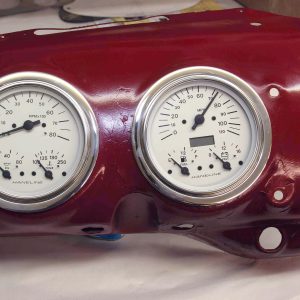
Say you drive an older pickup in which the original designers weren’t all that interested in engine management. Thanks to the addition of that high-horsepower engine, however, you are very interested in what it is up to. But you are also interested in keeping the dash area clean and don’t want to put a bunch of holes into it. You also don’t really want to have an old-style gauge panel hanging beneath the dash. What to do? For those who drive a 1947-’53 Chevrolet pickup truck, the ideal way to handle this problem is to install Haneline’s 3-in-1 gauge clusters.
Custom Meets Prefab
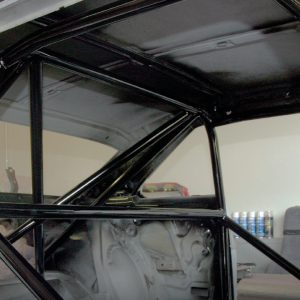
If you have spent any amount of time working on street machines, you are well aware that “bolt-on” parts do not always bolt right on. Still, it’s often a lot easier to modify those parts than to fabricate your own. The same holds true for such items as rollcages. Nobody pretends that a prefab cage is going to drop right into place without having to trim a single tube. That’s mainly because the economies of scale dictate that manufacturers make a single design fit as many cars as possible. Unfortunately, a cage that fits many cars probably fits no car perfectly.
Spotlighter
POPULAR READS
-
The Auto Builder’s Hottest Product Picks from The Triple Crown of Rodding 2026
-
Product Spotlight: Bill Mitchell Products Aluminum LS Engine Block
-
PRODUCT SPOTLIGHT: 60-66 Chevy C10 Fresh Air Vent Block Off Plate
-
Product Spotlight: Pyramid Optimized Design Sequential Aurora Taillight for 1964½–1966 Mustang
FINDING THE RIGHT C10
It Takes Time and Know-How
Author
Dave Hill
Story & Photography
The Action Line C10 series, produced from 1967 to 1972, is one of the most popular of the classic era of Chevy trucks. They have been transformed into every form imaginable, from sweet shop trucks to double-throwdown showstoppers, from strip-burning quarter-pounders to boulder-flattening off-roaders, and certainly everything in between. We’ll long remember the days when a black ’70 stepside would pass you on the street, dumped low in the front with Americans all around, running fat rubber out back and sweet-sounding exhaust dumping out in front of the rear wheels. You just knew that guy had something trick in the garage at home, too.
Those were among the first pickups to begin the transition from work vehicles to daily drivers, and they are very likely responsible for today’s transportation picture, in which there are far more pickups sold than passenger cars. That probably happened because the missus got a kick out of driving and being seen in hubby’s cool stepside, which ignited the prettier peoples’ interest in owning their own trucks. If you didn’t have a C10 stepside back when they were readily available, you probably wanted one. We all know you want one now or you wouldn’t be reading this article. Unfortunately, unless you find one of those older gearheads who still has his black stepside, finding a decent C10 to build these days is not as easy as it was 25 or 30 years ago. These trucks are going on 50+ years old now, and since they were great drivers to begin with, they have a whole lot of miles on them. Probably the best way to buy one is if it’s been recently well restored. It will cost you a bundle, but you’ll be money ahead in the long run.
What we’re showing you here is either what to expect if you plan to do your own work, or what to look for and avoid if you don’t. If you are serious about finding the right C10, you’re going to have to be patient, determined and, above all, able to resist the impulse buy. If you find one locally, SAVE THIS ARTICLE, get the truck up on a lift, as we did, and go over it thoroughly. If you have to buy it sight unseen, or just from pictures, all you can go on is the owner’s “honest” description. Such was the case with our example here: a very nice-looking ’70 Fleetside found on eBay. It was the exact model that the new owner was looking for, and it had a “built” 350 with a B&M trans. The seller answered all the questions to the buyer’s satisfaction, so he decided that the risk was justified. The truck was located in the Midwest, requiring a $900 transport to California.
At first glance it looks like a winner, especially with the built engine and trans, the new wheels and tires, and the cleanliness and completeness. But appearances can be deceiving, very deceiving, so let’s have a closer look. Follow along and learn where and what to look for before you close the deal. Happy hunting!