Complete Camaro Overhaul
So, despite the car’s condition, German began tearing the Camaro apart down to the last nut and bolt and began rebuilding the suspension. He replaced the front control arms with tubular pieces from Detroit Speed & Engineering (DSE) and added a DSE coilover kit with Koni shocks and Afco springs, sway bar and spindles. To improve the steering, German added a Saginaw 600 quick-ratio steering box, and he installed JL8 front discs to improve stopping.
Custom Wheels and Tires
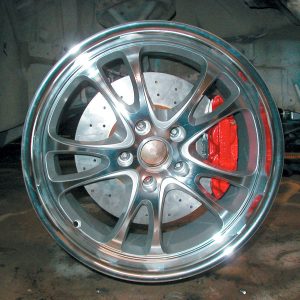
German said that, while he’s had Camaros with Torq-Thrusts before, he wanted something different for this car that would make it stand out. The wheels he decided on are the 17×8 Mesh design from ZE Forged, finished with powdercoated spokes and a polished lip. This style is more European than muscle car, and it definitely helps this Camaro stand out amid all the other F-bodies at any show its owner attends. And since this owner wanted his Camaro to handle, it needed great tires—and 245/40ZR17 BFGoodrich g-Force KDW rubber fits that requirement nicely.
Rear Axle and Suspension Upgrades
American Muscle installed a 12-bolt rear axle narrowed 2-1/2 inches and then fitted the housing with a Detroit Truetrac differential and 3.90 gears. Koni shocks and DSE 4-inch-drop leaf springs modernize the rear suspension and help keep the 18×10 ZE wheels and 295/35ZR18 BFGoodrich tires planted to the pavement. GM metric calipers are tough enough to fulfill the rear braking functions.
Engine and Performance Enhancements
Choosing an engine for the Camaro wasn’t an overly complicated task, as the owner chose an option proven time and time again. Stacy Crye built German a 358 small block based on a ’72 350 block bored 0.030 inch over and matched to an Eagle crank. GM pink rods and forged pistons round out the rotating assembly. The heads are Patriot aluminum castings with 64cc chambers, and they produce 10.75:1 compression. A Stealth 750 double-pumper carb sends the fuel into an Edelbrock RPM Air Gap intake manifold. The camshaft is an Isky hydraulic roller grind offering 238 degrees duration and 0.558-inch lift. Hedman headers and Flowmaster mufflers finish off the combustion process. On an engine dyno, the 358 proved good for 435 hp and can wind out to 6,800 rpm—ideal for a car that wants to snake its way around a windy road. From the outside, the engine is all business, with a black wrinkle-painted air cleaner and fabricated natural-finish valve covers in place of any chrome or billet accessories. Braided lines and AN fittings finalize the small block’s race-ready appearance.
Transmission and Cooling System
But for all the time German spends in the Camaro going fast, he will probably spend more time cruising with the family, so he selected a 700R4 automatic transmission for his ride. Randy Flowers prepared the transmission, pairing it with a 2,300-rpm stall converter, and American Muscle installed it in the car. The shop mated it to a pair of Derale fluid coolers, since nothing kills automatics like heat, and nothing makes heat like autocrossing or road racing.
Body Restoration and Customization
While there’s no doubt that a ’69 Camaro needs some alterations to make it a better-handling car, there’s nothing that such a car needs to make it any better looking. As such, American Muscle focused solely on restoring the body rather than changing it—at least on the outside. On the inside, the shop added DSE wheel tubs for some extra clearance around the big tires. The shop began with a good body, so most of the effort was concentrated on smoothing the metal as much as possible in preparation for its coats of black paint. Butch Phillips sprayed the ’69 in DuPont ChromaClear Black before adding the white SS stripes down the length of the body. This car is a genuine SS, but the builders also added RS hidden headlights and Z/28 badges to the grille and taillight panel. The front bumper is painted to match the body, while the rear remains in chrome. Modified RS taillights replace the originals, and the builders added a third bulb to the RS housings to provide some extra brightness. As such, the builders also cut the tail pan to install RS backup lights (SS models had integrated backup/taillight assemblies).
Interior Upgrades and Comfort
Anyone who’s ever tried to go fast through corners while sitting on a bench or even a factory bucket seat from the late 1960s knows that those seats aren’t the most supportive in the world. German needed seats that would keep him planted firmly in place, so he chose a set of Ractive buckets. B&M Trim in Cleveland, Tennessee, re-covered these seats in charcoal suede. The rear seat is gone entirely, as getting past the rollbar to sit in it would have been rather difficult. The dash is a functional affair, with Auto Meter Pro Comp gauges installed in a DSE housing and race-style toggle switches.
Final Touches and Attitude
A basic Grant steering wheel tops the factory tilt column, from which sprouts a pair of billet stalks for the wipers and more. A stock-style horseshoe shifter controls the automatic; ahead of the shifter is an Auto Meter trans-temp gauge, and behind it is a new center console with a pair of cupholders. After all, every second in this car won’t be at the limit. Look up and you’ll spot a huge multi-panel mirror intended more for circle-track racing than a street-driven Camaro. And despite this car’s go-fast purpose, it’s not without luxuries, thanks to Vintage Air Gen-II A/C and a Pioneer CD stereo.
The best thing about this Camaro is that its owner has the right attitude. German tells us, “This car is driven almost daily…scuffs and rock chips are a bummer but are a way of life for this car.” He’s not been afraid to take his ’69 to the dragstrip, where it ran a 12.8 in the quarter. He’s autocrossed the car at numerous Goodguys shows, and he always drives the car to the event as well. The car has even earned a few awards along the way, but it’s not the sitting still that the owner or his car enjoys. It’s only in motion that this car is at its best.