Tucci Engineering has turned out some killer cars in the past few years, and although Dave Tucci Sr. had his Willys coupe to tool around in, the younger Tucci found himself without a ride. What’s more, his wife, Jill, also wanted a street rod to call her own, and so it was time for the Tucci family to have a street rod meeting. Jill and Tucci Jr. decided what they really wanted was a full-fendered roadster that would be radical but also a driver.
Designing a New Highboy Roadster
About the same time the Tuccis decided to build a roadster, an opportunity arose to design a completely new highboy roadster for American Street Rod Design in Tennessee loosely based on a ’37 Ford roadster. After Tucci completed the design, American Street Rod Design produced one body. Tucci Engineering received the first and only body out of the mold and construction began in earnest.
The roadster project had barely begun, however, when a customer walked into the shop and just had to have the car, but he wasn’t interested in a daily driver; no, he wanted to go the full treatment and build a world-class street rod. Andy Guzzetti liked the idea of working with a local shop so that he could oversee the progress on the car and contribute thoughts and ideas along the way. Of course, Tucci Jr. realized this was one of the pitfalls of building street rods for a living—you never seem to get your own car done!
Shaping the ’35 Ford Look
As we mentioned, the fiberglass body is loosely based upon the ’37 Ford, but team Tucci had other plans for the car. They turned the clock back two years and decided to base the look on a ’35 Ford roadster. A quick call to Wescott’s Auto Restyling in Boring, Oregon, was all it took to have a full set of ’35 Ford fiberglass fenders delivered to the shop. The ’35 Ford rear fenders were molded to the fiberglass body, while up front the fenders were bolted in place. The front fenders remain basically stock with the exception of a small wedge ’glassed into the bottom to carry the laid-back lines of the car through to the fenders.
The addition of the ’35 Ford fenders transformed the entire look of the car, but it also necessitated forming a completely new hood for the car to accept a highly modified ’35 Ford grille. By sectioning a ’35 Ford grille 8 inches and forming custom grille bars from 1/4-inch stainless steel tubing, the tall and somewhat awkward grille becomes an integral part of the design. The grille bars were formed by first compressing them into an oval shape (3/16 by 5/16 inch), and then a special bending jig was built to ensure a uniform radius on the bottom of the grille. The stock outer grille band was modified and chromeplated before the entire grille was assembled between the fenders. One of the more pleasing design elements on the car is the manner in which the lower grille bars roll in the same flowing radius as the bottom of the front fenders. The grille was laid back on a 23-degree angle, providing a modern, swept-back look to the car.
Hood, Lighting, and Exterior Details
With the grille and fenders in place, a custom 0.080-inch 3003 aluminum hood and side panels were fabricated and fitted in place using hinges from Carolina Custom. The long hood top connects the grille shell and the body in seamless fashion, leading all the way back to the cut-down ’89 Saab coupe windshield. The side panels share a body seam with the front of the door for a clean look. A set of steel running boards was fabricated to connect the fenders and the basic look of the car was complete.
Of course, lighting is an all-important part of styling an automobile, and when it came time to select the headlights, Tucci recalled seeing a set of Harley-Davidson V-Rod headlights on a Speedstar coupe built by Jesse Greening. After some discussion with Greening, it was decided the V-rod lights would be perfect for the Tucci car. After constructing a pair of headlight buckets, the Harley lights were fitted to the front of the car, tucked in tight to the grille.
The rear lighting was a simpler affair; a set of ’37 Ford taillights was modified and attached to the rear fenders sans pedestals. A custom rear pan was formed to connect the ’35 Ford fenders, while a pair of stainless steel oval outlets integrates the exhaust system into the design of the car.
A Modern Chassis with Classic Roots
With a shape this exotic, it was only natural for the chassis to be both a forward-thinking and modern interpretation of the traditional hot rod chassis. The frame began life as a set of ’37 Ford side rails from Vision Street Rods. The rear of the chassis was redesigned by Tucci to accept the independent rear suspension designed by Precision Brake Company in Oregon. The wheelbase was stretched to a whopping 120 inches in the process. The suspension is centered around the Lincoln Mark VIII rear gear set with ’00 Corvette C5 hubs spun by a set of Moser outshafts. The entire rear suspension is mounted in a jungle-gym-like assembly of tubing. The front suspension comes from Paul Horton Street Rod Cars in Ontario, Canada. The Horton crossmember was narrowed 4 inches to fit within the confines of the ’35 Ford fenders, and a narrowed rack-and-pinion from Flaming River provides direction to the car.
Of course, with virtually all mod rods, adjustable suspension is a must for the all-important fairgrounds profiling, and to that end a full set of hydraulics was fitted to the car. A single pump with eight solenoids controls the ride height and comes complete with an 18-function remote, making this car more fun than a home entertainment center. Slowing the car down is a set of Wilwood disc brakes front and rear. Rolling stock for the chassis combines a set of “half-square” rear wheels (they’re half as wide as they are tall) measuring 20×10 inches, while the “little” front wheels are a mere 17×7 inches. Toyo tires provide ample grip and good looks, too.
Powertrain and Mechanical Finish
Powering this graceful street rod is 351 ci of Ford’s finest. The crate engine has been given the full cosmetic treatment with a ground block painted body color (PPG Copper Sunburst) by Steve Cater and Matt Engelart. The chassis was disassembled and sent to Best Products in Utica, New York, for a powdercoat in pewter silver. The suspension pieces are all either powdercoated, painted Copper Sunburst or polished alloy. After the paint cured on the engine block, Ford SVO dress-up goodies were bolted in place along with a set of Zoops pulleys and Power Master starter and alternator. A complete Barry Grant fuel system supplies gas to the 360hp Ford engine, with a 750cfm Demon carburetor topping off the engine. A custom-built aluminum radiator from Zero to Cool keeps the engine running cool.
Behind the highly detailed engine is a five-speed Ford Tremec transmission, which is engaged via a Ford Motorsport clutch package. The stainless brake and fuel lines from Pure Choice were installed and the chassis was complete, finished and detailed to perfection, awaiting the finished body.
Bodywork, Paint, and Interior Craftsmanship
Mike Winkelman of CNY Fiberglass installed a completely new floor in the car (to facilitate the highly modified chassis) using six layers of hand-laid fiberglass in the process. The underside of the body was then worked to perfection so the roadster would look as good on the bottom as it does on the top. With the body modifications completed, Tucci called upon the talents of Rich Thayer and Kevin Hansen from RJ Customs of Seattle, Washington. As we mentioned earlier, when you’re building a world-class street rod, it often involves finding craftsmen from all across the country. Thayer and Hansen made the trek from Washington state to upstate New York and spent a couple of weeks doing the final fit and finish bodywork on the roadster. After some 350 man-hours, the car was rolled into Rich Panella’s spray booth (Panella’s Collision in Mills, New York) for the gorgeous Copper Sunburst paint.
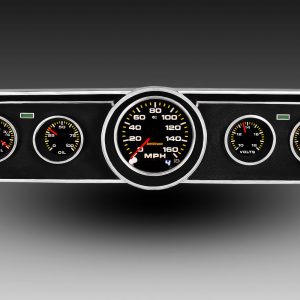
With the finish color on the car, all the body modifications were looking good, but time was now running short, for the car was to debut at the big SEMA Show in Las Vegas. The roadster was rolled into a trailer for a 3,000-mile ride to RJ Customs, where the body was completely disassembled for final sanding and buffing. As the polishing process was going on, Jamie McFarland of McFarland Custom Upholstery in Buckley, Washington, created a fabulous interior. By combining the subtle texture changes of perforated and smooth Mercedes-Benz leather over McFarland-built bucket seats, the interior was every bit as flowing as the exterior of the car. The dashboard was filled with Auto Meter gauges, and the Flaming River steering column is topped off with a billet aluminum steering wheel. After fabricating the seats, McFarland constructed a beautiful center console, incorporating a center ridge that mimics the crest of the front fenders and carried the same peak onto the hand-formed shifter knob.
SEMA Debut and Final Impressions
The roadster rolled out of McFarland’s upholstery shop one week before the SEMA show. Tucci hopped a flight to Seattle, and the seven-day thrash to complete the assembly and detailing began. Mark Usyk, Ryan Ostrander, Adam Paulson (of Tucci Engineering, Marcy, New York) and Jason Kilmer, Rich Thayer and Kevin Hansen (of RJ Customs, Seattle, Washington) spent every waking hour getting the car together. Finally, two days before the show, the car was loaded into Dennis McClendon’s trailer for the trip to Las Vegas, where the car was displayed at the Emgee Clean Tools booth.
The roadster was a resounding success, and the brilliant Copper Sunburst paint glistened under the exhibit hall lights. All of the work, time and worry were suddenly worthwhile. After the show, Scott Killeen took the car outside for a photo session. Catching the setting sun on the copper paint illustrates the fine lines, the graceful curves and seductive styling of the car. From the big billet wheels to the stretched wheelbase and one-off body, this a contemporary street rod in every sense of the word. Thanks to the talents of craftsmen from all across this great country, Team Tucci street rod has managed to produce yet another world-class street rod.