Mahoney’s Mustang Transformation
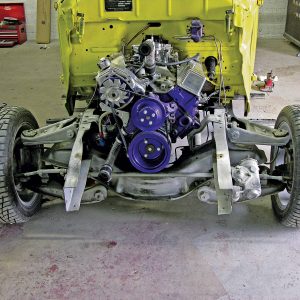
Mahoney made a wise decision by purchasing a rust-free car, but he quickly realized this Mustang had seen better days. Worn out in every way possible, this Mustang needed a structural update, so Mafco Customs built custom framerails to connect the front and rear subframes. Reducing flex in the body and chassis is always a good thing, and lowering the car’s center of gravity is also a step in the right direction when it comes to upgrading performance. That modification called for lowering springs, which also offer a higher spring rate to keep the car level, along with the larger sway bars. In addition to the subframe connectors, Mafco Customs fabricated a pair of lower control arms and strut rods for Mahoney’s Mustang, which improve upon Ford’s original design and offer increased durability.
Upgraded Rearend and Steering
Another upgrade comes from a 9-inch rearend equipped with disc brakes, which originally called a Lincoln Versailles home. Equipped with a 3.50 gear set and factory-style Lincoln disc brakes, the rearend rides on stock rear springs and Edelbrock shocks. Rack-and-pinion steering keeps the Mustang in line and a pair of stock spindles mounts the 17-inch five-spoke wheels. Originally from a 2006 Mustang GT, the wheels blend old and new styling and wear Pirelli 235/55 tires, which provide a better footprint and much-improved traction over original-style rubber. Even with the advances of radial tires, the sticky Pirellis have trouble hooking up thanks to a healthy dose of horsepower.
Engine and Performance
This Mustang’s powerplant consists of a 5.0-liter block, bored 0.030 inch over, which raises the overall displacement to 306 ci. A stock rebuilt bottom end provides plenty of power while also giving Mahoney a strong engine he can count on. A pair of Edelbrock Performer cylinder heads, which have larger ports and valves for additional horsepower gains, controls airflow after receiving a mixture of fuel and air from the BBK SSI intake manifold. Fuel supply is handled by a collection of 24-pound injectors, while air enters the small-block Ford through the custom cold-air intake and K&N filter. This combination of air and fuel is turned into power, thanks to a Ford Racing E-303 camshaft and an MSD ignition system. Mahoney’s Auto Service handled the entire engine build and dressed the small-block Ford in a nice variety of polished-aluminum and chromeplated components. The well-detailed mill looks right at home under the hood of Mahoney’s Mustang and is surrounded by bright red sheetmetal. Backing this potent small block is a rebuilt T5 manual transmission, which came from the same donor car as the engine.
Post-Crash Repairs
We mentioned that this Mustang presented quite a problem to the Mahoneys, but it was after the car was first completed that things turned bad. Dale and Dorinda Mahoney were heading back from a car show in Michigan when the car immediately spun around and shot across three lanes of traffic and into the concrete barrier in the median. After bouncing off the wall, the Mustang was struck by an oncoming pickup, further damaging the wounded thoroughbred. Luckily, Mahoney’s Auto Service is also a wrecker service, and the car caught a ride to Indiana on a rollback. And when it arrived at Mahoney’s shop, it was back to work as the car was disassembled to repair the damage.
Restoration and Finishing Touches
After the crash, the Mustang spent some time at Bryte Car Collision in Highland, Indiana, where Keith Bell repaired the damage and gave Mahoney’s Mustang the slick finish you see here. The chin spoiler and custom side skirts were fabricated by Mafco Customs and were added after the crash to give the Sportsroof a more contemporary look. Bell used the purest red and black mixing colors available from DuPont to create the two-tone paint scheme and slathered the base colors with several coats of clear for the ultimate shine. Countless hours of sanding, buffing and polishing ensued to eliminate any imperfections in the fresh finish, and the finished product is nothing less than stunning. One look at the final product shows the effort put forth by Keith Bell, and a glance at the interior reveals Mahoney’s comfortable surroundings.
Interior Details and Final Impressions
Of course, black and red are the colors of choice, and vinyl provides the old-school feel every time Dale Mahoney slides behind the Grant steering wheel. Six JME Enterprises gauges ride in the custom cluster and provide Mahoney with a clear view of his engine’s vital signs. Power for all the accessories comes from a Painless wiring harness. Dumping the left pedal engages a Centerforce clutch, while a Hurst shifter allows Mahoney to bang the gears with ease.
While it gave Dale and Dorinda Mahoney some trouble after its initial completion, this two-tone ’69 Mustang turned out great and caught our eye immediately at the 2007 World Ford Challenge in Indianapolis, Indiana. Obviously, it grabbed the attention of other Ford enthusiasts as well, and how can we argue with that? Is it the paint, stance, wheel selection or small details that make it stand out? We think it’s the mixture of all those things in one super-nice package. Whether it’s your cup of tea or not, this Mustang has seen its share of ups and downs, but it’s finally complete—just as long as there are no more wrecks.