The Joys and Community of Street Rodding
For most, street rodding is a celebration of creativity expressed in what they build and drive. Some enjoy it for the visceral pleasure that comes from screaming horsepower and boiling rubber, while others benefit more from the family environment this hobby provides. One of the benefits of this mix is the variety of people who take part in this rolling celebration of personal art. They come from every walk of life and from all parts of the nation and the world, and most share a common goal of having good times with cars in the way they see fit.
A Nostalgic Approach to the ’34 Ford Roadster
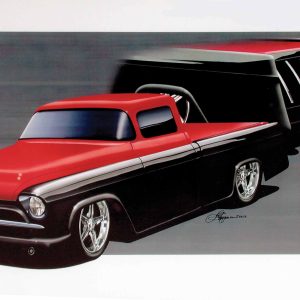
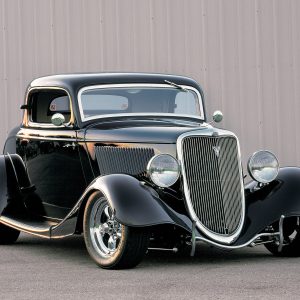
In the case of this ’34 Ford roadster, the owner wanted to take a nostalgic approach with this, his latest ride, albeit with some 21st-century detailing thrown in to meet the needs of a modern world. His needs were simple and his requests were few, yet his goals were high. The original concept was based on several images from the past, including Jim “Jake” Jacobs’ ’34 coupe and Jack Moran’s ’34 roadster. It also centered on Thom Taylor’s rendering of a ’34 cabriolet, and while this is a roadster, the basic idea carried over seamlessly.
Building the Car in South San Francisco
Finally, there was one other element that was a must, and that was some “Bay Area pinstriping,” which has gained favor with the owner over the years. The car was to be built in South San Francisco by Roy Brizio Street Rods, so that last request was a natural. And, with their considerable capability and track record, the rest of his requests were easily met by the folks at Brizio Street Rods.
The Project Begins with a Fiberglass Body
While the focus of this project was basically nostalgia, a fiberglass body from Rat’s Glass was opted for along with one particular piece that was shared by the aforementioned cars, a ’37 Ford truck grille. It just so happened that the owner had a body for the car, so he sent it and the grille all the way from Memphis, Tennessee, to California to get the project underway.
Crafting the Chassis
The chassis began taking shape about that time, and, as you might expect, the list of hardware was short and straightforward. After all, nostalgic highboy roadsters aren’t particularly complex, although they do require a special kind of detailing to reach their full potential. In this case, the detail was applied to original-style framerails that were joined in a late-model fashion, with tubular crossmembers ensuring absolute rigidity and simplistic beauty. However, from the outside, it’s pure nostalgia. A Chassis Engineering dropped axle rides a Durant monoleaf spring, with Pete and Jakes spindles, shocks and radius rods, a Mullins steering box and column, and a So-Cal front disc brake kit providing a solid foundation.
Assembling the Rearend and Chassis
A 9-inch Ford rearend with 3.70 gears was joined with a ’40 Ford spring and another pair of Pete and Jakes shocks and ladder bars, and once the chrome and polished pieces from Sherm’s Plating were in place, the package was looking good. With the polished stainless steel brake lines and fasteners, it was definitely good to go, at least when everything else was ready. From there, all that was needed was a set of Coker wide whites and Wheel Vintiques’ 16-inch steelies, rings and caps to get this chassis on a roll.
Modifying the Front Grille
By this time, Jim Hendricks had brought subtle change to the front grille, removing 3 inches from its width, similar to what had been done on the cars mentioned earlier. The look is nostalgic, yet, because there just aren’t that many examples out there, it’s also fresh and perfect for this slick ’34, especially when joined with a three-piece aluminum hood from metal master Jack Hagemann.
Perfecting the Body and Paint
While the body looked pretty good to start with, Brizio called upon Paul Camilleris at Camilleris Auto Works in San Carlos, California, to bring it to near perfection. This involved a good deal of careful preparation work topped with DuPont’s single-stage black paint that is as deep and flawless as it gets. Then came one of the critical touches, the “Bay Area pinstriping” by Rory, which is reminiscent of the work done in the 1950s and 1960s by Tommy the Greek. Lighting comes from vintage-style Arrow headlamps, with ’37 Ford taillights in back above a Hagemann roll pan.
Installing the Drivetrain
Back at the shop, Brizio’s crew was busy fitting the drivetrain, although it may not be what you expect. As we said, this car has some 21st-century details, one of which is a Ford Racing 351 with 362 hp and tons of torque, mated to Ford’s T-5 five-speed overdrive gear slapper. No, it doesn’t have the nostalgia look of a Flathead, but the engine/tranny combination has everything else, and it has proved to be more than adequate in shooting this roadster from state to state. What’s more, it looks good doing it. With accessories like the Edelbrock 600cfm four-barrel and a few other special touches, there’s just enough brightwork to set it off. And, of course, reliability was kept in the mix with a Walker Cobra radiator working in combination with Vintage Air’s 15-inch fan.
Crafting the Interior
For the interior treatment, Brizio once again looked to the skills of Sid Chavers, one of the true gentlemen in this hobby, who has created his own style while helping others do the same with his excellent series of instructional videos. As always, Chavers’ approach centers on simplicity, and although the white and red Naugahyde is certainly vivid, it was a natural for the ’50s approach. When joined with Classic Instruments gauges, a Bell-style steering wheel from Antique Auto Parts and other unique pieces, the appeal of this car cannot be denied. Brizio looked to longtime friend Jim Vickery to lay out the wiring, this time with a kit from Enos. And if you think we forgot to mention the tunes, there aren’t any. After all, when you’ve got the wind in your hair and the pedal down in a roadster like this, you’re making all the music you need.
The Vision Behind the Car
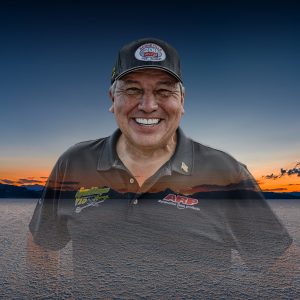
Now for the reason the car exists. It was just over a year ago that Brizio received a call from a fellow rodder about building a ’34 Ford roadster. Through every step of the process, the owner allowed Brizio total freedom to do as the crew has done before. Now that the car is complete, another page of rodding history has been written, as this collection of parts and modifications will go down as a significant statement in all of street rodding. It tells of the special people who built a special car for a special person. A man of few words, a man who has done a lot for our own community, and who has done a great deal for so many. A community leader, a philanthropist, an entrepreneur—they all are a part of the makeup of this man who loves to build hot rods. But if you ask George Poteet, he’s just another car guy following a dream like all the rest of us. This just happens to be his latest vision.