The Spread of Straight-Axle Fever
The fever is an affliction spreading throughout the ranks of hot rodders, and some medical experts say it could grow to epidemic proportions. The only known cure for Straight-Axle Fever is to elevate the driver on a high-altitude angle, effectively raising the car and driver to “nosebleed level.” Once elevated, multiple hard accelerations should be made, thereby thrusting the driver back in the seat. While this is not a complete cure, at least it will treat the symptoms. As Straight-Axle Fever progresses, it generally requires harder acceleration for shorter periods to control the disease.
Moore’s Cure Discovered at the Turkey Rod Run
As fate would have it, Moore found his own cure at the Daytona Beach Turkey Rod Run a few years ago. While perusing the thousands of cars (of which 90 percent are for sale), he came across a little black-and-white Rambler American station wagon. The car was lowered and the windows were tinted, but it was actually a sheep in wolves’ clothing. Under the hood, the stock Flathead six-cylinder was still mustering around 90 hp.
A Rambler With a Quiet Past
As it turns out, the owner was a friend of Moore’s, Mike Blewitt of Venice, Florida, a local rod builder of some renown. It seems Blewitt purchased the ’60 Rambler American from its original owner, the quintessential “little old lady” who drove the car “to the store on Saturday and to church on Sunday.” The odometer had 42,000 miles, and since the car was 45 years old, we figured that not only was she telling the truth, but she also might have skipped church a couple of times. Blewitt lowered the car a bit more, tinted the windows and just drove the wagon. Moore made an offer on the car and brought it home to his shop.
Reviving the Rambler
Moore continued to use the car for some three years, until the original Flathead “was down on power.” The time had come for a wagon revival. The stock driveline was completely removed, and Charlie’s Customs in Melbourne, Florida, fabricated a 2×2-inch chassis, which basically connected the Rambler front crossmember (remember, these were unibody cars) to the rear axle. The body was connected along the way, and, in the end, the simple 2×2-inch chassis was stout enough to mount the 9-inch Ford rear using Aldan coilover shocks and Pete & Jake’s drag hairpins.
Front-End Upgrades and Suspension Details
Up front, a Super Bell 4-inch dropped-and-drilled axle is mounted with SoCal hairpin radius rods. Super Bell disc brakes mount to early-Ford spindles, and the stock Rambler steering box still turns the front wheels. A set of 90/10 drag shocks and a Posies spring complete the front suspension. All of the suspension components were powdercoated in bright silver by Precision Powder Coating in Melbourne, Florida.
The Heart of the Beast: 350ci Small-Block
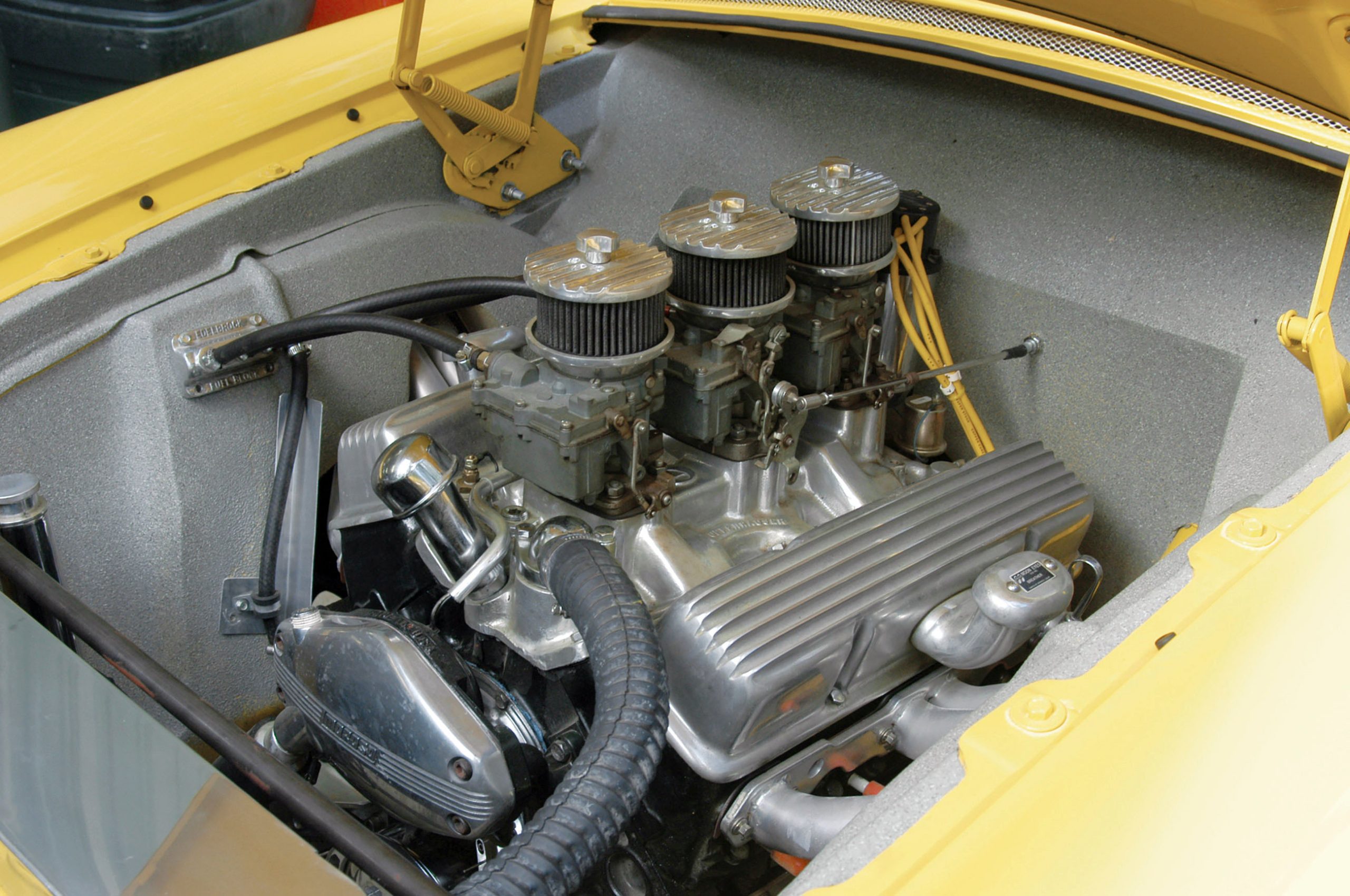
Power for the Rambler comes from an 0.030 over-bored 350ci small-block Chevrolet. The engine is dressed in traditional fare, with an Offenhauser three-deuce setup from Vintage Speed in Vero Beach, Florida. A Crane cam moves the valves in the 300hp 327 heads. The Vertex mag fires the plugs, and Hedman headers exit through the wheel wells in true Gasser fashion. Moon valve covers and breathers complete the cosmetic portion of the engine compartment. The engine produces 350 hp at 5,500 rpm.
Transmission and Drivetrain
Passing the power to the 9-inch Ford rear is a Winters manual Turbo 400 transmission topped with a B&M shifter and cooled by a B&M tranny cooler. A 3500 stall converter is in use, and JW Transmissions of Rockledge, Florida, handled the rebuild.
Bodywork and Paint: From Garage Queen to Gasser
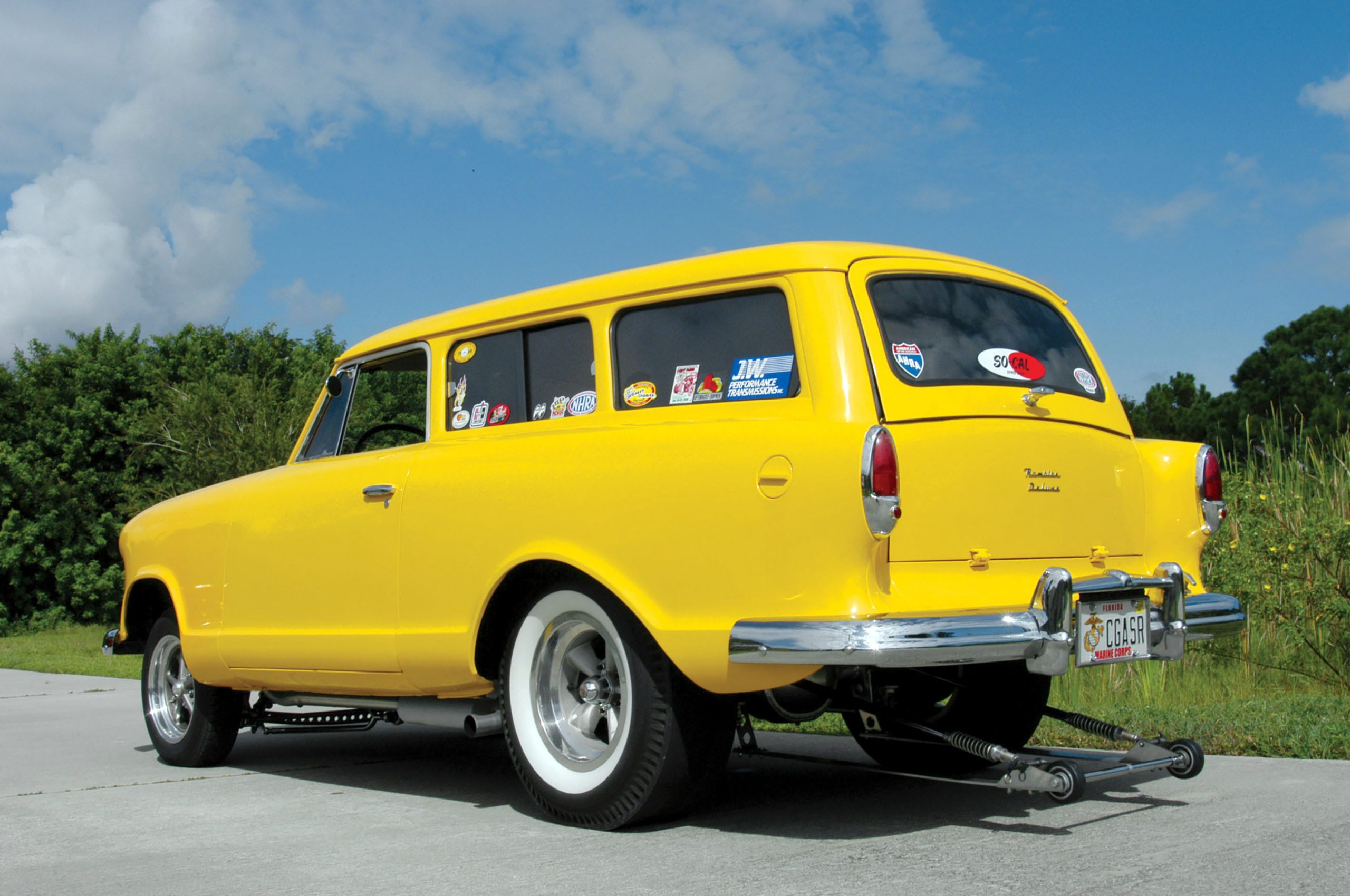
With the chassis and driveline completed, Moore turned his attention to the bodywork. Since the little old lady was kind enough to leave her Rambler in the garage for most of its first 45 years, bodywork was limited to stripping (by simply sanding off the original paint), repairing a few dings and prepping the car for the DuPont urethane Taxi Yellow paint. The firewall was modified to clear the engine and mount the Kugel side-mount master cylinder (under the dash). The rear inner wheel wells were “tubbed” 4 inches for slick clearance; however, the exterior of the car remains completely stock.
Final Paint and Finishing Touches
After the owner had the body straight and ready for paint, it was taken to Mark Stoecker at Marlin Body Shop in West Melbourne, Florida, where the final finish of Taxi Yellow was applied. The color change really brought the car to life, and with it sitting sky high in the front, it now looked like the All-American Gasser.
Interior Mods and Gasser Essentials
The next stop on the reconstruction trail was Pete’s Upholstery, where black vinyl was sewn over the stock front seat. Auto Meter gauges reside in the stock dashboard, and the original steering wheel and speedometer are still in service. A large, dash-mounted tach, floor-mounted fire extinguisher and four-point rollbar add Gasser flavor, and flaming floormats keep it hot. The B&M shifter is complete with line lock. The car is street legal and sees duty at local cruise nights, so you might think a radio would be inside, but as Moore so aptly put it, “Who needs a radio when you’re running Flowmaster mufflers?”
Debut and First Quarter-Mile Pass
The car was returned to Moore’s shop, and the week-long thrash of final details was completed just in time for the little Rambler to head north to Indianapolis for the annual Goodguys event. At that event, the car won Best Gasser, and the following weekend Moore arrived at the NHRA Hot Rod Reunion East and made his first quarter-mile pass in the car. He didn’t qualify for the “big show,” but he had a ball, with the car running in the mid-13s. Of course, like any racer, plans now call for a new 500hp small block, and as Moore told us, “I had the time of my life in Bowling Green, Kentucky. All I can think about is a 500hp small block that will pull the wheels even higher and turn 11s there next year.” We told you there’s no real cure for Straight-Axle Fever.