


THE AUTO BUILDER
Featured

Crossing JORDANS
We met Jeff Jordan at the 2004 Texas Street Machine Nationals, held at Lady Bird Johnson Park outside the city limits of picturesque Fredericksburg, Texas. Jeff and his Torch Red ’56 Chevrolet stepside pickup were attending the event, along with his brother, Rick, who owns a similarly hued Pro Street ’83 Chevrolet Silverado. We quite logically assumed that both Jeff and Rick were from Texas, but the reality was that brother Jeff had towed his ’56 all the way from Gilbert, Arizona, to attend the event and hang out with his brother, who lives in Harlingen, Texas. Not only would both Jeff and Rick’s Chevys win spots on the Texas Nationals Top 10 Truck list, but Jeff’s immaculate ’56 big-window also won the C&C Productions Long Distance award. Now let’s take a look at this beautiful half-ton hauler. “I built this truck with my son, Jeff Jr., as a father-and-son project, and it took 10 years to complete,” says Jeff Sr. Ten years?

’65-’66 MARK IV
The birth of the Mark IV 396 for public consumption occurred back in 1965. Its predecessor, the Mark I, started in 1961 on the drawing board, was finalized and built in late 1962, and was unveiled in race trim in 1963. It set the racing world on its collective ear at Daytona and other races, and then it disappeared, going back to Chevrolet Engineering for further development. Seeing that you could step up and possibly own the Marilyn Monroe of big-block engines, serious racers and enthusiasts had to sit on their hands for two full model years (1963 and 1964) before the son of this absolute powerhouse could be ordered.

JOHNSON & JOHNSON ’CUDA
Say what you will, but function is back! We find more high-profile cars built to be driven, and driven hard. Everywhere you look, car owners and builders are searching out new ways to put the fun back into driving the wheels off the rides they build, and they’re looking to the past for their inspiration as they recreate older brands to kick the snot out of new, overpriced super cars. It’s an old technique, as aged as the hobby itself.
Spotlighter
POPULAR READS
-
Product Spotlight: Bill Mitchell Products Aluminum LS Engine Block
-
PRODUCT SPOTLIGHT: 60-66 Chevy C10 Fresh Air Vent Block Off Plate
-
Product Spotlight: Pyramid Optimized Design Sequential Aurora Taillight for 1964½–1966 Mustang
-
PRODUCT SPOTLIGHT: Cam Covers for GEN/3 Coyote from Pyramid Optimized Design
SOMETHING OLD WITH SOMETHING NEW
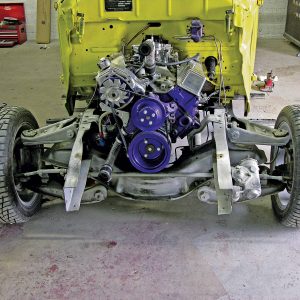
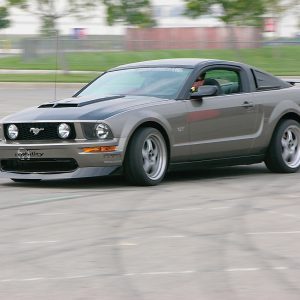
Blending New Camaro Performance With Vintage Camaro Style
Author
Will Smith
Photography Courtesy of Street & Performance
Which Camaro is Better, the ’68 or the ’98?
Here’s a question that ought to neatly divide our reading audience in two: Which Camaro is better, the ’68 or the ’98?
Although it probably won’t be too difficult for you to choose your favorite, no doubt you’ll also admit that each model has its advantages and disadvantages. One thing that both cars share is a healthy amount of power. The small blocks that came in ’68 Camaros—the 302, 327, and 350—were all cool, but when you get down to hard numbers, they come up just a little short of the ’98 LS1. However, there’s a lot you can do to those earlier motors to make them more powerful, so at first glance, swapping one for the other may not seem like an obvious move.
The Advantages of the LS1 Engine
It’s difficult to think of any area in which the early small blocks compare favorably to the LS1. Though they make similar power, the LS1 is undoubtedly more economical, more reliable, and in some ways, easier to service (help is only a Chevrolet dealer computer away). Add to these advantages the pure cool factor that comes from swapping new motors into old cars, and the allure of the LS1, not to mention the LS6, becomes almost mesmerizing.
How to Swap an LS1 Into Your Camaro
The easiest way to put an LS1 in your Camaro is to call GM and order one of its brand-new crate motors and wiring harnesses. “Easiest” however, should not be confused with cheapest. The crate motor route is expensive and beyond the reach of most enthusiasts’ budgets. But don’t think that just because you can’t afford a crate motor, you can’t afford an LS1. Just as you would have done 30 years ago, it’s still possible to go to a good wrecking yard, find a late-model engine, and place it in the car of your choice. The main difference between 30 years ago and now is that today you’ll need a lot more help figuring it all out.
The Expertise of Street & Performance
Before you even consider such a swap, you should call Street & Performance, which knows how to swap an LS1 into just about anything, as well as swapping just about anything into a Camaro. The shop knows both ends of the equation, including the problems you may encounter, and it has already developed the parts you’ll need to get around those problems. S&P may even find you a donor motor and/or transmission, so it could take only one call to get virtually everything you need to complete this swap (short of oil).
The Value of S&P’s Experience
S&P provides more than just hardware. It offers a great blend of knowledge, experience, and the ability to try things that haven’t been done before. When S&P gets it right—as it always does—you’re the one who benefits.
ARTICLE SOURCES
Street & Performance, Inc. - CLOSED
#1 Hot Rod Lane
Mena, AR 71953
479/394-5711