Michelle Holstien’s Passion for Cars Begins
Michelle Holstien of Moreno Valley, California, grew up with a passion for cars. She took auto shop in high school for two years, and her dad, Bruce, helped her build a ’72 Ford Econoline van and a ’62 Econoline pickup.
A Lifelong Dream: The Boss 302 Mustang
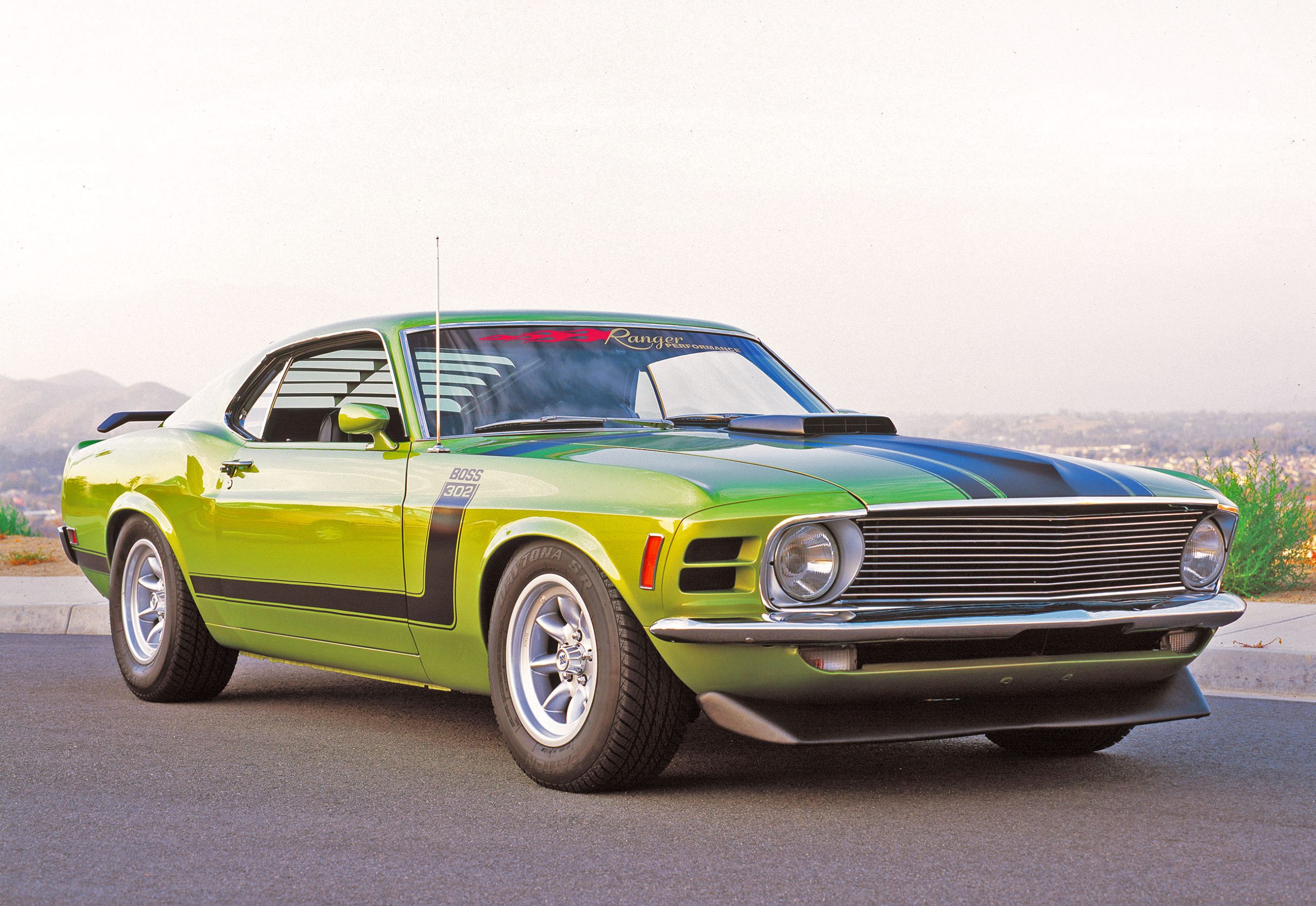
But she really had her heart set on a Boss 302 Mustang. Just listen to her talk about the Boss: “For as long as I can remember, I have always had an interest in Bosses. They are so different from a regular ’65-’66 Mustang, which is what’s popular. The reflective-sticker package (although the hood is not reflective) is unique; the taillight bezels are flat black but argent around the lenses; the chrome Magnum 500 wheels were an option but popular; the front fender lips were cut out and rolled under to clear a wider tire; the sport slats and spoilers were also options.
What Makes the Boss 302 So Special
“The car came with higher-rated springs, stagger-mounted shocks, quick-ratio 16:1 steering, heavy-duty spindles and front and rear sway bars. A tach was supplied with the optional instrument panel; a Hurst Competition Plus shifter was used; the engine had a forged-steel crank, windage tray and huge ports; intake valves were 2.19-inch; compression was 10.5:1; and the finned aluminum valve covers topped it off. A Ford top-loader four-speed was used along with an extra-heavy-duty 9-inch rear axle with the famous nodular housing with 3.50:1 gears (3.91:1 or 4.30:1 were optional). The axles were Ford’s heavy 31-spline. This was a bad-ass car already in stock trim!”
Chasing the Dream Despite the Odds
Holstien bought all the books she could find on Trans-Am-style racing featuring Bud Moore, Parnelli Jones, Dan Gurney and George Follmer, and just Bosses in general. She learned all she could about the car, but she knew it was out of her price range as a waitress and veterinarian’s assistant. But she kept saving her money and hoping that one day she’d come across a Boss 302 that needed work and was affordable. It happened.
Finding the Right Boss 302
“I met this guy Roy at a car show,” Holstien told us, “and he told me he had a Boss that had been sitting since 1988 and that it was totally disassembled and he was letting it go for $10,000. I went to his house and looked at the car. It was very nice but needed a lot of work and TLC. He had most of the parts in boxes, and the engine and trans had been pulled out. A previous owner had disassembled the car in 1986, and all the paint and bodywork was completed. Roy bought the car in 1999 but had no time or money (or whatever), so it sat and sat (covered).
Overcoming Setbacks and Going All In
“I called Roy for two years after I met him at the show and he kept giving me the runaround. I took several days off work so I could meet with him to pick up the parts and the car, but he always backed out. Then I found out it wasn’t his car; it belonged to a friend, and he was just storing it at his house. I found out the real owner’s name and went around Roy to deal directly with the real owner. The only problem was that now the price changed to $17,000. I had already told myself I wouldn’t go over $15,000 because I needed to have some money to fix the car, too.
Sacrifice and Determination
“I worked two jobs and got my associate of science degree in business administration at the same time, so it was very hard to do all three, but I didn’t want anyone to help me financially. I ended up deciding to pay the $17,000 because I knew it was worth it. Bosses go for $35,000 to $40,000 right now. I got a small loan to fix up the motor. I picked up the car from Brian (the owner) at Roy’s house (you can imagine that uncomfortable scene) and trailered it to Ranger Performance (909/734-5051) in Riverside, California, for interior assembly.
The Restoration Process Begins
“After Ranger installed the interior, they painted the undercarriage black. Then Ranger fabricated a grille, a console, upper and lower radiator hoses, a battery cover, overflow box and radiator cover. I did help Attila Vecsernyes (from Ranger) with the lowering of the car, and I did a lot of the motor work and helped drop it into the car. I’m proud of this car, mainly because I understand what it really takes to get one and how much time, money, and work that goes into it to make it the way it is today.”
A Show-Worthy and Daily-Driven Muscle Car
Holstien (and Ranger) had the car completed in about six months. Holstien spent about $13,000 in addition to the purchase price. She built the engine with the help of Larry Binder Sr. and Jr. and her dad. The end result could be treated as a pampered show car, but that wouldn’t be Holstien’s style. She drives the car nearly every day. And she takes it to plenty of shows, where she’s won awards for Best of Show, Best ’70s, Best Engine Compartment and more. One of the highlights of the project was taking the car to Laguna Seca’s Pre-Historics track day. She put three laps on the car and then entered it in the car corral. While there, she was able to convince Parnelli Jones, Dan Gurney, George Follmer and Carroll Shelby to autograph her glovebox door. She’s only missing Bud Moore’s signature.
Looking Ahead: Future Plans for the Boss
As someone who has put this much research and passion into one type of car, it’s no wonder Holstien has achieved so much at such a young age. Even this car isn’t completely done, and Holstien has plans to install a new intake. “The Cross-Boss intake and carb setup is something I plan to put on the car during the winter,” Holstien told us. “I purchased it off eBay about two years ago. It’s an inline four-barrel 1,425cfm carb. It was used in the ’69 and ’70 Trans-Am-series Bosses for a short period. The intake is a cross-ram manifold. It’s a two-piece manifold base with runners in a plenum chamber and a cover with the words ‘Cross-Boss’ across the manifold top.”