The Inspiration Behind the Restoration
The story behind Larry Way’s ’46 Jeep actually began many years ago when a young Bob Johnson used to hear his father say that one day he’d like to restore a World War II Jeep. As the years passed, both Johnsons became avid street rodders, and so the restoration of a Jeep seemed to fade into the background. Then, just a few years ago, the urge resurfaced for some military iron in the garage, so the Johnsons, father Ben and son Bob, decided to locate and restore a Jeep.
A Powerful Transformation
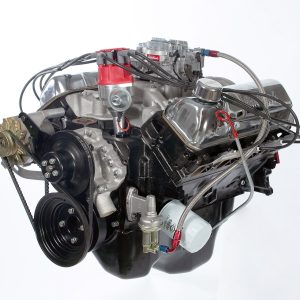
Well, by now the street rodding blood was running so true that even before they found a Jeep they decided they would need to find the smallest series Jeep built, and then, just for fun, stuff the biggest engine they could find under the boxy hood. To that end they secured one rather large engine. How large? Well, how about a 500ci Cadillac engine? For those of you who are metric minded, that works out to 8.2 liters. That should be large enough to motor-vate, say, a ’46 1/2-ton Jeep, don’t you think?
Of course, a stock 500-incher would have done the job just fine, but as we mentioned, the street rod fever was running strong in the Johnson garage, so the engine was brought to West Carlton Automotive, where a custom-grind camshaft was slipped into place. While they were in there, it seemed as if a set of Keith Black pistons would be a big improvement, and of course porting those big heads lets ample air and gas into the huge holes under the head. An Edelbrock intake and Holley carb feed the hungry Caddy, and Edelbrock chrome valve covers add a little flash. Behind the engine, a built Turbo 400 tranny spins a 2,800-rpm-stall torque converter.
Custom Frame and Suspension
After they located a ’46 1/2-ton Jeep, it was hauled back to the Johnson shop (Johnson Welding Works in Ottawa, Ontario, Canada) for “a little work.” Now, the work performed at the Johnson shop is a bit better and a whole lot wilder than what the Jeep was used to receiving down at the motor pool. To begin with, an entire new frame was fabricated from 2×4-inch box tubing. The frame was designed to widen the body 6 inches and lengthen it 10 inches. The front suspension is hand-formed independent by the Johnson shop with a Mustang II rack-and-pinion providing the steering. Out back, a 9-inch Ford rear was narrowed and filled with Strange axles. Four-wheel disc brakes stop the little Jeep with military precision. Rolling stock for the Jeep comes in the form of 14×4 steelies up front with “square” 15×15 wheels out back. Yes, they are as wide as they are round. Mickey Thompson Sportsman 29×18.5×15 rubber harness the luxurious and abundant Cadillac power, while Firestone 185/65R-14 tires turn the Jeep around. Every inch of the chassis was detailed to perfection, but before being painted, the ’46 Jeep body was mounted to the frame.
Custom Fabrication and Paint
It seems the only World War II parts to survive the “restoration” were the cowl, hood, grille and tailgate. Everything else was custom fabricated. In the process the body was widened 6 inches and lengthened 10 inches. The windshield frame was custom built, and that Willys logo on the windshield was downloaded from the Internet; a die was formed and the old logo was stamped into the frame. The rear fenders are heavily modified CJ2 units, while the front fenders were fabricated in the Johnson shop. All panels were formed without the use of an English wheel, since Jeeps just aren’t very curvaceous.
When the body panels were fit and the metal was straight, several coats of green paint were applied. Now, anyone could have laid down a rust barrier of olive drab, but the Johnson boys went one better with an outrageous electric green from Chrysler called “Get ’Em Green.” The wheels were painted to match in true military tradition. After all, this is a “restoration.”
Interior and Final Touches
On the inside of the Jeep, a custom-fabricated bench seat holds two people, while a large chromeplated rollbar protects occupants from unexpected vehicle inversion. The steering column is from a Pontiac Sunbird and the tilt option is one they didn’t have during World War II. A B&M star shifter selects the gears in the Turbo 400 below. The custom-fabricated dashboard is steel with aluminum inserts and VDO gauges. Down on the floor we find diamond-plate steel floors covered with bed-liner material, and Lokar pedals add a touch of class. A waterproof (after all, this is a roadster in the truest sense of the word) Clarion marine stereo pumps the booming power to Bazooka marine speakers. All things electrical are operated by the American Autowire harness.
A Satisfying End Result
It took the Johnson boys about a year to get the old Jeep back in service, but when it hit the road, all the work was worthwhile. The Jeep is faster than a rocket launcher, pretty as a pinup and as reliable as a Cadillac. After a year or two on the road, Larry Way purchased the Jeep, and after detailing it a little and tidying it up, he continues to enjoy this very cool Jeep.