From Boats to Street Rods
Building custom boats and street rods may seem worlds apart to some, but actually, the concepts involved in each bring these two high-powered worlds closer than a casual observer might think. For Barron, the connection to speed and beauty is an obvious one. Barron’s journey into street rod building began with another high-speed hobby, a love of those machines not connected to the Earth via land or sea—airplanes. But it wasn’t until he hung up his wings and sold his airplane that he developed this more grounded passion for super rodding.
A Foundation Built Long Before the Roadster
Actually, building cars isn’t at all new to Barron. Before his boat-building days began, he learned the art of woodworking and paint finishing on old station wagons. Barron fancies himself not only a critic, but also a creator of design trends, and a look at his line of custom fiberglass boats, ranging from 21 to 55 feet, showcases the breadth of that vision. And it is for these reasons that Barron agonized so over the who, what and how of this dream street rod.
Discovering the Muroc II Roadster
Barron’s research brought him to Jerry Kugel of Kugel Komponents in La Habra, California, and to the new, beautifully styled limited-production Muroc roadster that Kugel introduced last year. After looking at the striking new design of the fenderless and full-fendered roadsters (Kugel planned to build just 10), Barron decided to write the check, join the unique list of prospective Muroc owners, and begin his foray into building a top-notch hobby rod.
Why an All-Metal ’32 Matters
It’s ironic that in today’s world of high-dollar fiberglass street rod bodies (Boyd Coddington has since introduced a fiberglass version of his Boydster), and particularly for a man who has built his fortune on molding fiberglass, that Barron would choose an all-metal body. Of course, this isn’t a Dearborn-stamped barnyard body. This ’32 Ford body was handmade by Marcel’s Custom Metal in Corona, California. The hood, made from aluminum, was also pounded out by Marcel’s custom shop.
Design Without a Designer
Although two of the top super rod designers, Chip Foose and Thom Taylor, had a say in the overall idea and design highlights of the Muroc, Kugel actually cut and screwed together the basic buck that went to Marcel’s to be copied. In Kugel’s words, “There was never a finished design for the car.”
Chassis, Suspension, and Engineering Excellence
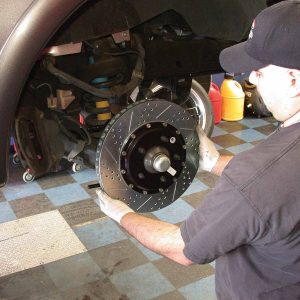
The custom all-metal body was fitted to a specially designed Kugel chassis, which incorporates his enormously popular IFS front and IRS rear suspension designs. The custom Kugel front end features a stainless steel independent suspension with 11-inch Wilwood rotors, Wilwood calipers, cast stainless A-arms, coilover shock absorbers, rack-and-pinion steering, and a geometry that has been so widely embraced by knowledgeable rod builders. A Flaming River steering column is fitted to the Kugel rack, providing the kind of steering input normally associated with cars much more serene than this Corvette-powered custom roadster. The brake lines are stainless steel and utilize the customary Wilwood proportioning valve.
The business end of the rectangular framerail chassis incorporates a naturally fitted Kugel independent rear suspension system, utilizing 9-inch Ford gears, cast stainless steel A-arms and polished coilover shocks. The inboard brakes incorporate Corvette PBR calipers and Wilwood rotors and match the beautifully milled and polished rear gear cover and housing.
Powertrain and Assembly
These cars, all 10 of them, come only as rollers from Kugel, and include features such as a specially formed windshield, center hood piece, and matching rearview mirrors. The doors, hood and trunk are mounted and installed, as are the fenders in the full-fendered Muroc. The chassis is completed with mounts for your engine of choice, and in Barron’s case, that was the new-generation LS6 Corvette small-block. Once the body and chassis were completed by Kugel’s shop, Barron commissioned Mike’s Street Rods to do the various installations.
Never one to shy away from horsepower, and since the car is named after a place where land speed records are set, Barron had Mike’s custom finish the Corvette LS6 engine, accessorize it for the car, and install a 4L60E transmission in the chassis. To allow proper breathing for the big-block Chevy, an MNM-designed all-stainless-steel exhaust system was installed.
Where Two Worlds Truly Converge
It is at this stage that Barron reached into his bag of boat-building experiences to finish the car. It is here where the worlds of custom boats and street rods converged.
Beginning with the basics, you choose a style, an engine package, as well as a color scheme. It is the personalization and customization of each of these types of specialty cars that allow the builder to incorporate his creative influences—choosing the right mix of parts, making them fit and function as designed, and also building them so that they are integral with the overall envelope of the vehicle.
Marine Influence in the Interior
Barron began this process with the dash. Utilizing his marine industry resources, Barron turned to Gaffrig Instruments, a premier gauge company in the marine industry. Gaffrig built a 4-in-1 gauge sporting the Hallett logo, and a Gaffrig GPS speedometer was installed, something you are sure to see more of in future buildups. There is no need to adjust for tire and wheel size on this car to ensure that the correct speedo gear is selected; no, the accuracy of this readout is taken directly from above.
Another contribution from the marine industry was the fuel tank. IMCO Marine, known for its performance parts, including its exhaust and final-drive systems, fabricated the one-off stainless steel fuel tank for the ’32 Muroc.
Finish, Details, and Final Accolades
Being in the paint and gel-coat business, and long known for the special finishing that is so pleasing to his customers, Barron has access to a mind-numbing assortment of colors and designs. But rather than rewrite the trend toward the unusual, Barron instead chose a solid-red paint hue and subtle tan interior. The car was again sent to Mike’s Street Rods for bodywork and paint. Gabe’s Custom Interiors then did the leather upholstery.
Hallett Boats is known among performance boat owners as an innovative company. In keeping with this tradition, Barron felt he needed a “trick” feature on his roadster. His answer was a vacuum-operated light and license bar that drops down when the motor is running and retracts when the motor is turned off. Other interesting touches on the car include the Headwinds Custom Headlight assemblies from Monrovia, California, and the billet smoothie wheels by Boyd Coddington Wheels.
In keeping with the uniqueness of Kugel’s design, this car was built to perfection. In fact, its first outing was to a local car show in Nevada, where it took top honors. Its second outing was to the Goodguys West Coast Nationals in Pleasanton, California, where the car was awarded “America’s Most Beautiful Street Rod.” And it was named one of the “10 Best Super Rods Of The Year” by SUPER ROD Magazine. Not bad for a guy who just decided to get into super rodding.