



THE AUTO BUILDER
Featured

AN AMERICAN TRADITION
Here in the United States, we have been conditioned to find vintage tin in many places. The availability of good cars to build into street rods has become more limited as the years have passed, but depending upon your choice of bodies, there are still quite a few options. Of course, the advent of reproduction bodies has added to the choices. Now put yourself in a foreign land and think about how hard it would be to find a good 70-plus-year-old imported American car to build. That is what Wayne Streams faced as a native of the United Kingdom. Building street rods has grown in both popularity and participation in the UK. There are many vintage English vehicles available, but American cars are the most cherished among British rodders.

RESURRECTION
While cruising down an old Southern Virginia back road some 38 years ago, Ted Hayes, along with a couple of local friends, happened upon a well-worn ’37 Chevy Master Deluxe coupe. Now, mind you, it looked nothing like the gem here. It had original paint, and the interior had seen better days, but it was complete and running. At some time during its life, the Chevy had received a 327 and a four-speed trans, a familiar combination for a vintage car during the 1960s.

REDEEMING THE FORGOTTEN Y-BLOCK
When Ford introduced its Y-block engine in 1954, it labeled the engine the worthy successor to the venerable Flathead. The Flathead gained a loyal following of hot rodders and racers, but the big Cadillac overhead-valve V-8 and Oldsmobile’s Rocket 88 were stealing Ford’s thunder in terms of power, so something had to be done, and Ford decided to respond. The answer was a clean-sheet V-8 design, featuring overhead valves and improved cooling compared to the old Flathead. It was dubbed the “Y-block” because of the way it looked and because of its deep skirt and tall cylinder heads.
Spotlighter
POPULAR READS
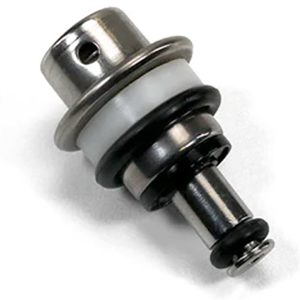
PRODUCT SPOTLIGHT: DeatschWerks Performance In-Tank Regulators
+50HP for $39... that’s $1.28 per HP!
Author
The Auto Builder Staff
Photos Courtesy of DeatschWerks
In the realm of high-performance automotive engineering, fuel flow reigns supreme as the lifeblood of optimal power delivery. DeatschWerks emerges as a game-changer with their Performance In-Tank Regulators, engineered to unleash the true potential of EFI engines.
The Ingenious Engineering
Crafted to support EFI powerplants ranging from 250HP to a blistering 700HP, DeatschWerks’ Performance In-Tank Regulators redefine the limits of fuel management. This technological marvel boasts a staggering 309% increase in flow over stock ITR with a stock pump, and a substantial 154% bump with the DW300c. Moreover, these regulators seamlessly accommodate both ethanol and gasoline, ensuring adaptability across a spectrum of fuel types.
Precision Craftsmanship Meets Unyielding Durability
What distinguishes DeatschWerks regulators is the seamless fusion of OEM compatibility, premium construction, and precision performance. From its hard-anodized aluminum body to its stainless hardware and nitrile-fiber diaphragms, every component speaks volumes of quality and resilience. These regulators aren’t just engineered to perform; they’re built to endure the rigors of high-performance environments.
The Power Surge
By integrating a DeatschWerks Performance In-Tank Regulator, enthusiasts can unlock an additional 50 horsepower of fuel flow. This surge in delivery translates to tangible gains in acceleration and overall performance, whether tearing up the track or dominating the street scene. It’s not just an upgrade; it’s a revolution in power delivery.
For aficionados and professionals immersed in the world of automotive performance, the DeatschWerks Performance In-Tank Regulators epitomize a quantum leap in fuel system innovation. To learn more, CLICK HERE or go to the DeatschWerks website.
ARTICLE SOURCES
DeatschWerks
415 E Hill Street
Oklahoma City, OK 73105
405/217-0701