A Rough Start with a Vision
Steve Pimentel describes the condition of his ’69 Mustang fastback at the time of purchase as poor. But he does concede that the body was at least fairly straight. Still, his family and neighbors were all of the opinion that the $2,700 purchase price was about the same amount too much for the hulk. Fortunately, the proud new owner could see past the car’s current condition. He saw how he wanted it to look, and to him, that made the purchase well worth it. Oh, and the other thing that made the purchase worth the price: the trunk, full of brand-new parts.
Building the Powerhouse
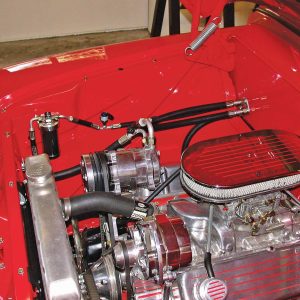
During the course of the project, the owner met new friends Frank Bulot and Mitch Philpot, and these two performed the mechanical buildup on Pimentel’s Mustang. In return, Pimentel applied his trade as an automotive detailer to their cars. The engine is the 302 that originally came in the car, but was rebuilt so it is now more powerful than before. Internal components include a Comp Cams camshaft and Keith Black pistons. The heads are Edelbrock Performers with Erson roller rockers, and the intake is also an Edelbrock Performer. The Barry Grant Demon 650 carb sits inside a polished enclosure for the polished Paxton SN93 supercharger, which produces a relatively mild 5-1/2 lbs of boost. Likewise, the Ford Racing valve covers are also polished aluminum. When you throw in the shock tower brace and the dress-up plates that surround the engine, shine is something this engine isn’t short on.
Power Meets Performance
The engine is anything but short on power, and the power equation continues with MSD and Mallory ignition components to light the air/fuel charge, and Hooker competition headers. Once past the Hookers, the exhaust flows through 3-1/2-inch stainless tubing to Flowmaster mufflers to make sure the engine sounds the way a Mustang should. This engine combination produces well over 400 hp, and there’s a C4 automatic located behind the engine to help put the power to the ground.
Suspension and Handling Choices
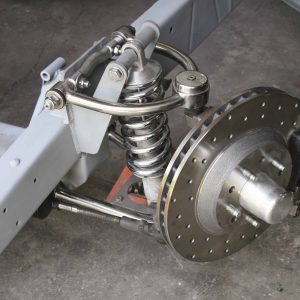
The car’s suspension is stock. Despite the potent engine, this Mustang is more of a cruiser than a racecar, so leaving the suspension mostly stock made sense and also saved a lot of money. Changes included 3.89 gears in the 9-inch rearend and heavy-duty sway bars. But modern wheels and tires are things that every cool cruiser needs, so Pimentel updated that aspect of his ’69. Both ends of the car wear 17-inch KMC 562 aluminum wheels, but the rears are wider than the fronts; each wears 275/40R17 and 235/45R17 BFGoodrich Comp T/A tires, respectively.
A Unique Paint Choice
The owner describes the paint as it was on the car when he bought it as a three-stage paint consisting of faded factory paint, Earl Scheib touch-up and freestanding Bondo—you get the idea. Fortunately, the body was fairly straight. The main concern was choosing a color that looked right on this Mustang.
The Perfect Yellow
After considering various blues and reds for the car, Pimentel decided that the car would look good in yellow. Still, finding the right yellow was the challenge. After visiting every car dealer he could find to examine all factory yellows, he finally found what he was looking for when he spotted a Spa Pearl Yellow Acura NSX. Even after deciding on this color, the owner wanted something that would really make the car stand out from all the other yellow Mustangs in the world. He decided on a checkered-flag graphic motif that would surely distinguish the car from the others. While he had been choosing a color, Pimentel had taken the car to Evans Auto Body in San Bernardino, California. The shop performed all the bodywork, even when the owner picked his color and graphics, laying down the base yellow as well as the checkered flags. The shop ended up putting a lot more effort into the car than they imagined, but the finished results speak for themselves. The painters even stuck to their original price estimate! Ranger Performance’s Attila fabricated the custom billet grille inserts in not only the grille but also the hood scoop.
Bringing the Exterior Inside
The seats are the originals and are covered in factory-style black vinyl upholstery. Still, the cabin is filled with custom touches, most of which bring the vibrant yellow exterior color inside the car. The seatbelts are all yellow, as are the Mustang logos on the floor mats. Each door panel contains bright yellow inserts. The instrument cluster shares the same feel as the original design, but yellow gauge faces replace the standard issue black faces. There are also three Auto Meter Sport Comp gauges festooned about the steering column to measure rpm, oil pressure and water temp. The middle of the dash also houses another Auto Meter gauge to keep track of boost. As he surveys these gauges, the driver controls the car via a LeCarra steering wheel and B&M shifter. Further accessories include billet window cranks and autographs from Mustang legends Carroll Shelby and Parnelli Jones.
A Project Fueled by Passion
It took Steve Pimentel 3-1/2 years to bring his Mustang into the shape you see here, though he says it is still a work in progress. With it, he’s garnered numerous trophies, and even had the car featured on TV shows such as My Classic Car. But that’s not what is important to him. This is one owner with a good attitude, and he shows it best when he says he measures his car “by how many friends I’ve met along the way.” It’s good to know that the best reasons for building a car are not forgotten.