Built To Handle Serious Horsepower
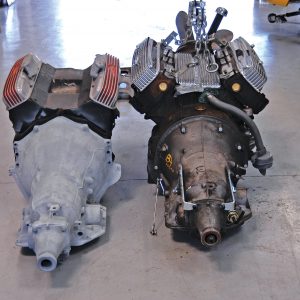
It takes a tough transmission to handle the kind of power this engine is capable of producing, but Chevrolet has seen to it that the tranny is no standard off-the-shelf item. Chevy has modified their 4L80HD 4-speed automatic transmission to be a high-performance piece in its own right.
All-Wheel Drive Changes Everything
Think that all that power combined with little weight over the rear end would make this a vehicle that is just looking for an excuse to spin? Not with this rig. In an effort to make this a true high- performance vehicle, the C-II has been equipped with—get this—all wheel drive! That’s right. Using technology developed for Chevrolet’s Pikes Peak hill climb race trucks, the C-II is equipped with a New Venture Gear viscous coupling all-wheel-drive system. There’s never an out-of-control moment with all the wheels hooked and pulling. Do you have a friend with an Audi Quattro? Tired of listening to him brag about how well his car works in the corners? With the huge power and AWD capabilities of the Coolside II, you can now take him to a twisty road that has a few long straights in it, and wipe that Euro smirk off his face.
Lower, Tighter, and More Responsive
But the Coolside can do it with more than just brute force. In addition to the AWD, Chevy has modified the frame and suspension components, making it ride 3 inches lower than a stock 1500, and handle in a much more responsive way than any stock C/K pickup. The front suspension remains independent even with the AWD. The front differential is equipped with 373 gears and is mounted to the frame and coil springs do the work up front. No such independent luck in the rear however, as a solid rear axle is held in place with leaf springs. Granted, they are high-quality units from the suspension pros at Hotchkis, but no IRS.
Brakes Worthy of the Performance
Another area where Chevy went all out is with the brakes. The Stillen front disc brakes feature six-piston calipers and huge 355×35.5 rotors. The rotors are directionally vented and have been cross-drilled and slotted as well. Out back, a set of floating GM single-piston calipers puts the squeeze on the 280×24 drilled and slotted solid rotors.
Rolling Stock That Matches the Mission
In another happy departure from the norm and rather than try to design their own wheels, Chevy deferred to the experts and outfitted the C-II with stylish 18×10-inch Budnik Famosa wheels. And in keeping with the ultra high-performance standards that they have strived for with the rest of the C-II package, Goodyear Eagle F1 tires have been mounted up.
Exterior Details That Demand Attention
It has been said that what is inside is what counts, but the exterior of the C-II makes the argument that it is what’s on top that matters. Taking cues from the show-and-shine crowd, the C-II sports many trick touches such as the 2000 Aurora door handles. There is also the one-off front airdam complete with Tahoe Z71 fog lights and the rear rollpan that features molded in exhaust pockets. The height of the tailgate has been raised, but not too much as there is a tonneau covering the bed made from aluminum sheets with a honeycomb center.
Flames, Attitude, and No Apologies
Once again, Chevy was true to their go all-the-way game plan with the C-II. There is a hot rodding adage that says that if you are gong to flame something: flame it! With the black base in place, multihued flames lick over the hood, fenders and doors and even appear on the tonneau cover. A truly striking display!
A Proper Performance Interior
Continuing the black color scheme to the interior is an understatement as nearly everything is black leather save for the red insert on the bucket seats and the trim on the steering wheel. We are not saying this is a bad thing. There is way too much gray that is being foisted upon the masses in what are supposed to be performance vehicles. Race cars have black interiors, period.
The Verdict
The verdict? “Wow” just doesn’t seem to fit, but that is usually the first response one has upon seeing the Chevrolet Silverado Coolside II. A startled, overwhelmed “wow” (usually followed closely by an expletive). “The reaction has been fantastic,” said John Moss, Manager of Chevy/Geo Specialty Vehicles. “The Cool-side has enjoyed a great deal of attention from the racing world. People love the Coolside and all the high-performance and appearance modifications it sports. They can’t believe this performance vehicle is a truck.” We can’t believe it took Chevy so long to build it. But we are definitely happy that they did; now we want it in production.